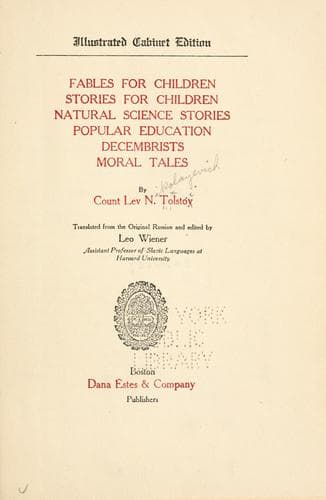
Fables for Children, Stories for Children, Natural Science Stories, Popular Education, Decembrists, Moral TalesTolstoy, Leo, graf
General
Fables for Children, Stories for Children, Natural Science Stories, Popular Education, Decembrists, Moral Tales
Tolstoy, Leo, graf
Russian literature -- Translations into English
This is precisely what Mr. Evtushévski does; but why it is all so
remains inexplicable to him who is looking for actual reasons and does
not become entangled in such words as psychology, didactics, methodics,
heuristics. I advise all those who have no inclination for philosophy
and therefore have no desire to verify all those deductions of the
pedagogues not to be embarrassed by these words and to be assured that
a thing which is not clear cannot be the basis of anything, least of all
of such an important and simple thing as popular education.
All the pedagogues of this school, especially the Germans, the founders
of the school, start with the false idea that those philosophical
questions which have remained as questions for all the philosophers from
Plato to Kant, have been definitely settled by them. They are settled so
definitely that the process of the acquisition by man of impressions,
sensations, concepts, ratiocinations, has been analyzed by them down to
its minutest details, and the component parts of what we call the soul
or the essence of man have been dissected and divided into parts by
them, and that, too, in such a thorough manner that on this firm basis
can go up the faultless structure of the science of pedagogy. This fancy
is so strange that I do not regard it as necessary to contradict it,
more especially as I have done so in my former pedagogical essays. All I
will say is that those philosophical considerations which the pedagogues
of this school put at the basis of their theory not only fail to be
absolutely correct, not only have nothing in common with real
philosophy, but even lack a clear, definite expression with which the
majority of the pedagogues might agree.
But, perchance, the theory of the pedagogues of the new school, in spite
of its unsuccessful references to philosophy, has some value in itself.
And so we will examine it, to see what it consists in. Mr. Bunákov says:
"To these little savages (that is, the pupils) must be imparted the main
order of school instruction, and into their consciousness must be
introduced such initial concepts as they will have to come in contact
with from the start, during the first lessons of drawing, reading,
writing, and every elementary instruction, such as: the right side and
the left, to the right--to the left, up--down, near by--around, in
front--in back, close by--in the distance, before--behind,
above--below, fast--slow, softly--aloud, and so forth. No matter how
simple these concepts may be, I know from practice that even city
children, from well-to-do families, are frequently, when they come to
the elementary schools, unable to distinguish the right side from the
left. I assume that there is no need of expatiating on the necessity of
explaining such concepts to village children, for any one who has had to
deal with village schools knows this as well as I do."
And Mr. Evtushévski says:
Public-domain text, read in full here on John Shaqi.
Reviews
Reviews
No reviews yet
Be the first to share your thoughts on this work.
Elsewhere in the archive
Join the Discussion
Join the discussion
Sign in to leave a comment or review.
Sign InorCreate an account