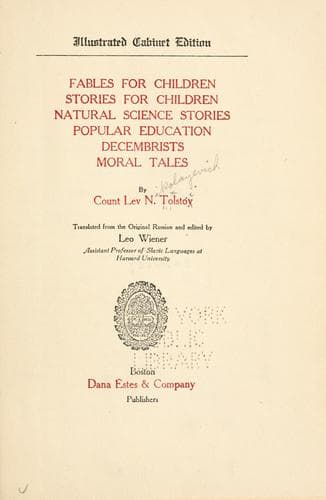
Fables for Children, Stories for Children, Natural Science Stories, Popular Education, Decembrists, Moral TalesTolstoy, Leo, graf
General
Fables for Children, Stories for Children, Natural Science Stories, Popular Education, Decembrists, Moral Tales
Tolstoy, Leo, graf
Russian literature -- Translations into English
"The teacher from the start establishes the order which is necessary for
the success of his work: each pupil is to answer only when asked to do
so; all the others are to listen and should be able to repeat the words
of the teacher and of their companions; the desire to answer, when the
teacher directs a question to everybody, is to be expressed by raising
the left hand; the words are to be pronounced neither in a hurry, nor by
drawing them out, but loudly, distinctly, and correctly. To obtain this
latter result the teacher gives them a living example by his loud,
correct, distinct enunciation, showing them in practice the difference
between soft and loud, distinct and correct, slow and fast. The teacher
should see to it that all the children take part in the work, by having
somebody's question answered or repeated, now by one, now by another,
and now by the whole class at once, but especially by rousing the
indifferent, inattentive, and playful children: the first he must
enliven by frequent questions, the second he must cause to concentrate
themselves on the subject of the common work, and the third he must
curb. During the first period the children ought to answer in full, that
is, by repeating the question: 'We are sitting in the class-room' (and
not in brief, 'In the class-room'); 'Above, over my head, I see the
ceiling;' 'On the left I see three windows,' and so forth."
Mr. Evtushévski advises that in this way be begun all the lessons on
numbers from 1 to 10, of which there are to be 120, and which are to be
continued through the year.
"One. The teacher shows the pupils a cube, and asks: 'How many cubes
have I?' and taking several cubes into the other hand, he asks, 'And how
many are there here?'--'Many, a few.'
"'Name here in the class-room an object of which there are
several.'--'Bench, window, wall, copy-book, pencil, slate-pencil, pupil,
and so forth.'--'Name an object of which there is only one in the
class-room.'--'The blackboard, stove, door, ceiling, floor, picture,
teacher, and so forth.'--'If I put this cube away in my pocket, how many
cubes will there be left in my hand?'--'Not one.'--'And how many must I
again put into my hand, to have as many as before?'--'One.'--'What is
meant by saying that Pétya fell down once? How many times did Pétya
fall? Did he fall another time? Why does it say once?'--'Because we are
speaking only of one case and not of another case.'--'Take your slates
(or copy-books). Make on them a line of this size.' (The teacher draws
on the blackboard a line two or four inches in length, or shows on the
ruler that length.) 'Rub it off. How many lines are left?'--'Not
one.'--'Draw several such lines.' It would be unnatural to invent any
other exercises in order to acquaint the children with number one. It
suffices to rouse in them that conception of unity which they, no doubt,
had previous to their school instruction."
Public-domain text, read in full here on John Shaqi.
Reviews
Reviews
No reviews yet
Be the first to share your thoughts on this work.
Elsewhere in the archive
Join the Discussion
Join the discussion
Sign in to leave a comment or review.
Sign InorCreate an account