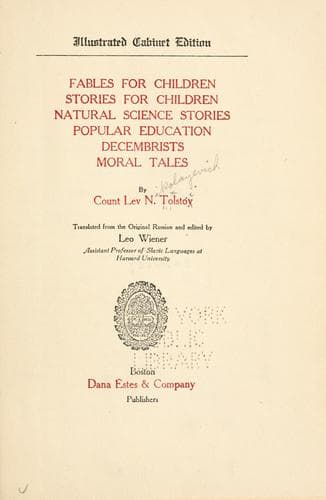
Fables for Children, Stories for Children, Natural Science Stories, Popular Education, Decembrists, Moral TalesTolstoy, Leo, graf
General
Fables for Children, Stories for Children, Natural Science Stories, Popular Education, Decembrists, Moral Tales
Tolstoy, Leo, graf
Russian literature -- Translations into English
Then Mr. Bunákov speaks of exercises on the board, and so on, and Mr.
Evtushévski of the number four with its decomposition. Before examining
the theory itself of the transmission of ideas, the question
involuntarily arises whether that theory is not mistaken in its very
problem. Has the condition of the pedagogical material with which it has
to do been correctly defined? The first thing that startles us is the
strange relation to some imaginary children, to such as I, at least,
have never seen in the Russian Empire. The conversations, and the
information which they impart, refer to children of less than two years
of age, because two-year-old children know all that is contained in
them, but as to the questions which have to be asked, they have
reference to parrots. Any pupil of six, seven, eight, or nine years will
not understand a thing in these questions, because he knows all about
that, and cannot make out what it all means. The demands for such
conversations evince either complete ignorance, or a desire to ignore
that degree of development on which the pupils stand.
Maybe the children of Hottentots and negroes, or some German children,
do not know what is imparted to them in such conversations, but Russian
children, except demented ones, all those who come to a school, not only
know what is up and what down, what is a bench and what a table, what is
two and what one, and so forth, but, in my experience, the peasant
children who are sent to school by their parents can every one of them
express their thoughts well and correctly, can understand another
person's thought (if it is expressed in Russian), and can count to
twenty and more; playing with knuckle-bones they count in pairs and
sixes, and they know how many points and pairs there are in a six.
Frequently the pupils who came to my school brought with them the
problem with the geese, and explained it to me. But even if we admit
that children possess no such conceptions as those the pedagogues want
to impart to them by means of conversations, I do not find the method
chosen by them to be correct.
Thus, for example, Mr. Bunákov has written a reader. This book is to be
used in conjunction with the conversations to teach the children
language. I have run through the book and have found it to be a series
of bad language blunders, wherever extracts from other books are not
quoted. The same complete ignorance of language I have found in Mr.
Evtushévski's problems. Mr. Evtushévski wants to give ideas by means of
problems. First of all he ought to have seen to it that the tool for the
transmission of ideas, that is, the language, was correct.
Public-domain text, read in full here on John Shaqi.
Reviews
Reviews
No reviews yet
Be the first to share your thoughts on this work.
Elsewhere in the archive
Join the Discussion
Join the discussion
Sign in to leave a comment or review.
Sign InorCreate an account