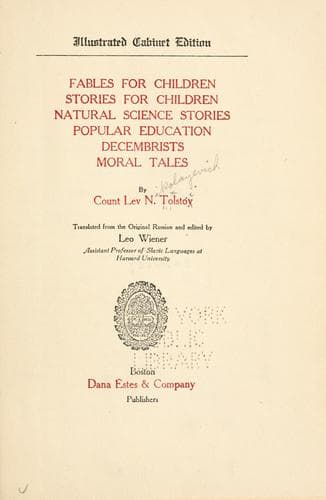
Fables for Children, Stories for Children, Natural Science Stories, Popular Education, Decembrists, Moral TalesTolstoy, Leo, graf
General
Fables for Children, Stories for Children, Natural Science Stories, Popular Education, Decembrists, Moral Tales
Tolstoy, Leo, graf
Russian literature -- Translations into English
Involuntarily the question arises: Do the children know, or do they not
know, what is so well explained to them in these conversations? If the
pupils know it all, then, upon occasion, in the street or at home, where
they do not need to raise their left hands, they will certainly be able
to tell it in more beautiful and more correct Russian than they are
ordered to do. They will certainly not say that a horse is "covered"
with wool; if so, why are they compelled to repeat these questions just
as the teacher has put them? But if they do not know them (which is not
to be admitted except as regards the suslik), the question arises: by
what will the teacher be guided in what is with so much unction called
the programme of questions,--by the science of zoology, or by logic? or
by the science of eloquence? But if by none of the sciences, and merely
by the desire to talk about what is visible in the objects, there are so
many visible things in objects, and they are so diversified, that a
guiding thread is needed to show what to talk upon, whereas in objective
instruction there is no such thread, and there can be none.
All human knowledge is subdivided for the purpose that it may more
conveniently be gathered, united, and transmitted, and these
subdivisions are called sciences. But outside their scientific
classifications you may talk about objects anything you please, and you
may say all the nonsense imaginable, as we actually see. In any case,
the result of the conversation will be that the children are either
made to learn by heart the teacher's words about the suslik, or to
change their own words, place them in a certain order (not always a
correct order), and to memorize and repeat them. For this reason all the
manuals of this kind, in general all the exercises of development,
suffer on the one hand from absolute arbitrariness, and on the other
from superfluity. For example, in Mr. Bunákov's book the only story
which, it seems, is not copied from another author, is the following:
Public-domain text, read in full here on John Shaqi.
Reviews
Reviews
No reviews yet
Be the first to share your thoughts on this work.
Elsewhere in the archive
Join the Discussion
Join the discussion
Sign in to leave a comment or review.
Sign InorCreate an account