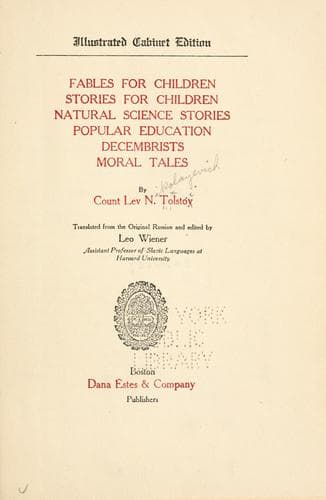
Fables for Children, Stories for Children, Natural Science Stories, Popular Education, Decembrists, Moral TalesTolstoy, Leo, graf
General
Fables for Children, Stories for Children, Natural Science Stories, Popular Education, Decembrists, Moral Tales
Tolstoy, Leo, graf
Russian literature -- Translations into English
What has been mentioned here refers to the form in which the development
is imparted. Let us look at the contents themselves. Mr. Bunákov
proposes the following questions to be put to the children: "Where can
you see cats? where a magpie? where sand? where a wasp and a suslik?
what are a suslik and a magpie and a cat covered with, and what are the
parts of their bodies?" (The suslik is a favourite animal of pedagogy,
no doubt because not one peasant child in the centre of Russia knows
that word.)
"Naturally the teacher does not always put these questions straight to
the children, as forming the predetermined programme of the lesson; more
frequently the small and undeveloped children have to be led up to the
solution of the question of the programme by a series of suggestive
questions, by directing their attention to the side of the subject which
is more correct at the given moment, or by inciting them to recall
something from their previous observations. Thus the teacher need not
put the question directly: 'Where can a wasp be seen?' but, turning to
this or that pupil, he may ask him whether he has seen a wasp, where he
has seen it, and then only, combining the replies of several pupils,
compose an answer to the first question of his programme. In answering
the teacher's questions, the children will often connect several remarks
that have no direct relation to the matter; for example, when the
question is about what the parts of a magpie are, one may say
irrelevantly that a magpie jumps, another that it chatters funnily, a
third that it steals things,--let them add and give utterance to
everything that arises in their memory or imagination,--it is the
teacher's business to concentrate their attention in accordance with the
programme, and these remarks and additions of the children he should
take notice of for the purpose of elaborating the other parts of the
programme. In viewing a new subject, the children at every convenient
opportunity return to the subjects which have already been under
consideration. Since they have observed that a magpie is covered with
feathers, the teacher asks: 'Is the suslik also covered with feathers?
What is it covered with? And what is a chicken covered with? and a
horse? and a lizard?' When they have observed that a magpie has two
legs, the teacher asks: 'How many legs has a dog? and a fox? and a
chicken? and a wasp? What other animals do you know with two legs? with
four? with six?'"
Public-domain text, read in full here on John Shaqi.
Reviews
Reviews
No reviews yet
Be the first to share your thoughts on this work.
Elsewhere in the archive
Join the Discussion
Join the discussion
Sign in to leave a comment or review.
Sign InorCreate an account