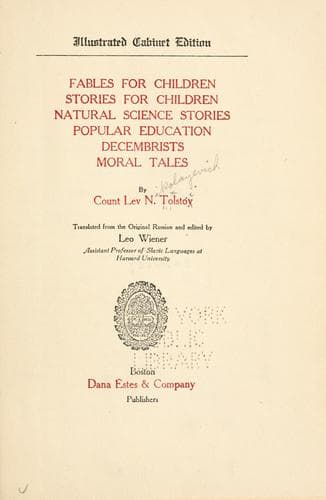
Fables for Children, Stories for Children, Natural Science Stories, Popular Education, Decembrists, Moral TalesTolstoy, Leo, graf
General
Fables for Children, Stories for Children, Natural Science Stories, Popular Education, Decembrists, Moral Tales
Tolstoy, Leo, graf
Russian literature -- Translations into English
Everything is arbitrary here: it is an arbitrary invention to say that a
fox could carry off a peasant's duck in winter, that peasants trap
foxes, that a fox sleeps in the daytime in his lair (for he sleeps only
at night); arbitrary is that hole which is uselessly dug in winter and
covered with boards without being made use of; arbitrary is the
statement that the fox eats horseflesh, which he never does; arbitrary
is the supposed cunning of the fox, who runs past the hunter; arbitrary
are the mound and the hunter, who does not shoot for fear of missing,
that is, everything, from beginning to end, is bosh, for which any
peasant boy might arraign the author of the story, if he could talk
without raising his hand.
Then a whole series of so-called exercises in Mr. Bunákov's lessons is
composed of such questions as: "Who bakes? Who chops? Who shoots?" to
which the pupil is supposed to answer: "The baker, the wood-chopper, and
the marksmen," whereas he might just as correctly answer that the woman
bakes, the axe chops, and the teacher shoots, if he has a gun. Another
arbitrary statement in that book is that the throat is a part of the
mouth, and so on.
All the other exercises, such as "The ducks fly, and the dogs?" or "The
linden and birch are trees, and the horse?" are quite superfluous.
Besides, it must be observed that if such conversations are really
carried on with the pupils (which never happens) that is, if the pupils
are permitted to speak and ask questions, the teacher, choosing simple
subjects (they are most difficult), is at each step perplexed, partly
through ignorance, and partly because _ein Narr kann mehr fragen, als
zehn Weise antworten_.
Exactly the same takes place in the instruction of arithmetic, which is
based on the same pedagogical principle. Either the pupils are informed
in the same way of what they already know, or they are quite arbitrarily
informed of combinations of a certain character that are not based on
anything. The lesson mentioned above and all the other lessons up to ten
are merely information about what the children already know. If they
frequently do not answer questions of that kind, this is due to the fact
that the question is either wrongly expressed in itself, or wrongly
expressed as regards the children. The difficulty which the children
encounter in answering a question of that character is due to the same
cause which makes it impossible for the average boy to answer the
question: Three sons were to Noah,[1]--Shem, Ham, and Japheth,--who was
their father? The difficulty is not mathematical, but syntactical, which
is due to the fact that in the statement of the problem and in the
question there is not one and the same subject; but when to the
syntactical difficulty there is added the awkwardness of the proposer of
the problems in expressing himself in Russian, the matter becomes of
greater difficulty still to the pupil; but the trouble is no longer
mathematical.
Public-domain text, read in full here on John Shaqi.
Reviews
Reviews
No reviews yet
Be the first to share your thoughts on this work.
Elsewhere in the archive
Join the Discussion
Join the discussion
Sign in to leave a comment or review.
Sign InorCreate an account