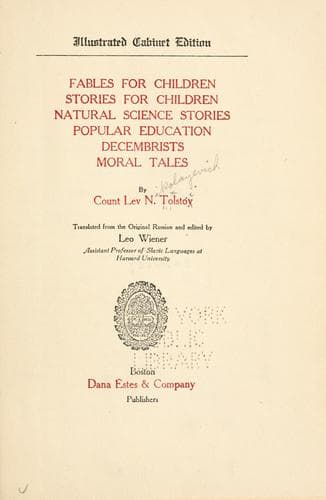
Fables for Children, Stories for Children, Natural Science Stories, Popular Education, Decembrists, Moral TalesTolstoy, Leo, graf
General
Fables for Children, Stories for Children, Natural Science Stories, Popular Education, Decembrists, Moral Tales
Tolstoy, Leo, graf
Russian literature -- Translations into English
[Footnote 1: The Russian way of saying "Noah had three sons."]
Let anybody understand at once Mr. Evtushévski's problem: "A certain boy
had four nuts, another had five. The second boy gave all his nuts to the
first, and this one gave three nuts to a third, and the rest he
distributed equally to three other friends. How many nuts did each of
the last get?" Express the problem as follows: "A boy had four nuts. He
was given five more. He gave away three nuts, and the rest he wants to
give to three friends. How many can he give to each?" and a child of
five years of age will solve it. There is no problem here at all, but
the difficulty may arise only from a wrong statement of the problem, or
from a weak memory. And it is this syntactical difficulty, which the
children overcome by long and difficult exercises, that gives the
teacher cause to think that, teaching the children what they know
already, he is teaching them anything at all. Just as arbitrarily are
the children taught combinations in arithmetic and the decomposition of
numbers according to a certain method and order, which have their
foundation only in the fancy of the teacher. Mr. Evtushévski says:
"Four. (1) The formation of the number. On the upper border of the board
the teacher places three cubes together--I I I. How many cubes are there
here? Then a fourth cube is added. And how many are there now? I I I I.
How are four cubes formed from three and one? We have to add one cube to
the three.
"(2) Decomposition into component parts. How can four cubes be formed?
or, How can four cubes be broken up? Four cubes may be broken up into
two and two: II + II. Four cubes may be formed from one, and one, and
one, and one more, or by taking four times one cube: I + I + I + I. Four
cubes may be broken up into three and one: III + I. It may be formed
from one, and one, and two: I + I + II. Can four cubes be put together
in any other way? The pupils convince themselves that there can be no
other decomposition, distinct from those already given. If the pupils
begin to break the four cubes in this way: one, two, and one, or, two,
one and one; or, one and three, the teacher will easily point out to
them that these decompositions are only repetitions of what has been got
before, only in a different order.
"Every time, whenever the pupils indicate a new method of decomposition,
the teacher places the cubes on a ledge of the blackboard in the manner
here indicated. Thus there will be four cubes on the upper ledge; two
and two in a second place; in a third place the four cubes will be
separated at some distance from each other; in a fourth place, three and
one, and in a fifth one, one, and two.
Public-domain text, read in full here on John Shaqi.
Reviews
Reviews
No reviews yet
Be the first to share your thoughts on this work.
Elsewhere in the archive
Join the Discussion
Join the discussion
Sign in to leave a comment or review.
Sign InorCreate an account