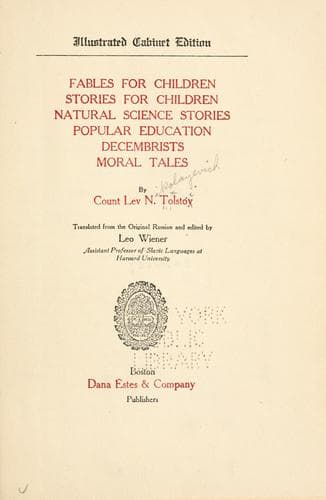
Fables for Children, Stories for Children, Natural Science Stories, Popular Education, Decembrists, Moral TalesTolstoy, Leo, graf
General
Fables for Children, Stories for Children, Natural Science Stories, Popular Education, Decembrists, Moral Tales
Tolstoy, Leo, graf
Russian literature -- Translations into English
In order to elucidate in what I find these unquestionable foundations of
every pedagogical activity, I shall be compelled to repeat myself, that
is, to repeat what I said fifteen years ago in the pedagogical
periodical, _Yásnaya Polyána_, which I then published. This repetition
will not be tedious for the pedagogues of the new school, because what I
then wrote is not exactly forgotten, but has never been considered by
the pedagogues,--and yet I still think that just what was expressed by
me at that time might have placed pedagogy, as a theory, on a firm
foundation. Fifteen years ago, when I took up the matter of popular
education without any preconceived theories or views on the subject,
with the one desire to advance the matter in a direct and
straightforward manner, I, as a teacher in my school, was at once
confronted with two questions: (1) What must I teach? and (2) How must
I teach it?
At that time, even as at the present, there existed the greatest
diversity of opinion in the answers to these questions.
I know that some pedagogues, who are locked up in their narrow
theoretical world, think that there is no other light than what peeps
through the windows, and that there is no longer any diversity of
opinions.
I ask those who think so to observe that it only seems so to them, just
as it seems so to the circles that are opposed to them. In the whole
mass of people who are interested in education, there exists, as it has
existed before, the greatest diversity of opinions. Formerly, just as
now, some, in reply to the question of what ought to be taught, said
that outside of the rudiments the most useful information for a primary
school is obtained from the natural sciences; others, even as now, that
that was not necessary, and was even injurious; even as now, some
proposed history, or geography, while others denied their necessity;
some proposed the Church-Slavic language and grammar, and religion,
while others found that, too, superfluous, and ascribed a prime
importance to "development." On the question of how to teach there has
always been a still greater diversity of answers. The most diversified
methods of instructing in reading and arithmetic have been proposed.
Public-domain text, read in full here on John Shaqi.
Reviews
Reviews
No reviews yet
Be the first to share your thoughts on this work.
Elsewhere in the archive
Join the Discussion
Join the discussion
Sign in to leave a comment or review.
Sign InorCreate an account