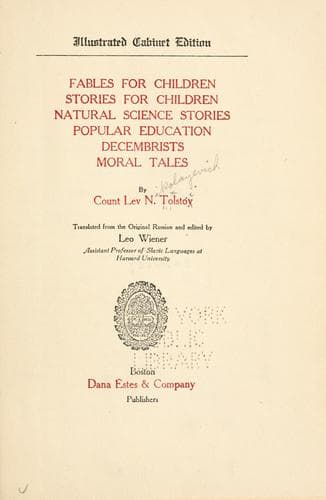
Fables for Children, Stories for Children, Natural Science Stories, Popular Education, Decembrists, Moral TalesTolstoy, Leo, graf
General
Fables for Children, Stories for Children, Natural Science Stories, Popular Education, Decembrists, Moral Tales
Tolstoy, Leo, graf
Russian literature -- Translations into English
This similarity continues down to the minutest details. In either method
all instruction previous to the school, all knowledge acquired outside
the school, is not taken into account,--all entering pupils are regarded
as equally ignorant, and all are made to learn from the beginning. If a
boy who knows the letters and the syllables _a_, _be_, enters a church
school, he is made to change them to _buki-az_--_ba_. The same is true
of the German school.
Just so, in either school it happens that some children cannot learn the
rudiments.
Just so, with either method, the mechanical side of instruction
predominates over the mental. In either school the pupils excel in a
good handwriting and good enunciation with absolutely exact reading,
that is, not as it is spoken, but as it is written. Just so, with either
method, there always reigns an external order in the school, and the
children are in constant fear and can be guided only with the greatest
severity. Mr. Korolév has incidentally remarked that in instruction
according to the sound method blows are not neglected. I have seen the
same in the schools of the German method, and I assume that without
blows it is impossible to get along even in the new German school,
because, like the church school, it teaches without asking what the
pupil finds interesting to know, but what, in the teacher's opinion,
seems necessary, and so the school can be based only on compulsion.
Compulsion is attained with children generally by means of blows. The
church and the new German school, starting from the same principles and
arriving at the same results, are absolutely identical. But, if it came
to choosing one of the two, I should still prefer the church school. The
defects are the same, but on the side of the church school is the custom
of a thousand years and the authority of the church, which is so
powerful with the masses.
Having finished the analysis and criticism of the German school, I
consider it necessary,--in view of what I have said, namely, that
criticism is fruitful only when, condemning, it points out how that
which is bad ought to be,--I consider it necessary to speak of those
foundations of instruction which I regard as legitimate, and on which I
rear my method of instruction.
Public-domain text, read in full here on John Shaqi.
Reviews
Reviews
No reviews yet
Be the first to share your thoughts on this work.
Elsewhere in the archive
Join the Discussion
Join the discussion
Sign in to leave a comment or review.
Sign InorCreate an account