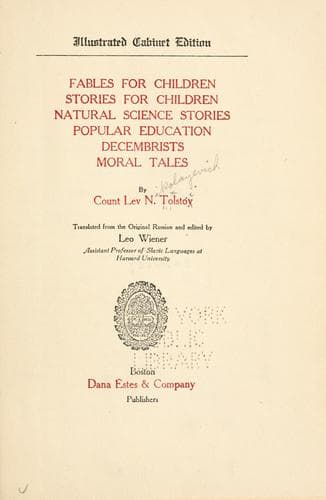
Fables for Children, Stories for Children, Natural Science Stories, Popular Education, Decembrists, Moral TalesTolstoy, Leo, graf
General
Fables for Children, Stories for Children, Natural Science Stories, Popular Education, Decembrists, Moral Tales
Tolstoy, Leo, graf
Russian literature -- Translations into English
And yet, this question is not quite so difficult if we only renounce
completely all preconceived notions. I have tried to elucidate and solve
this question, and, without repeating those proofs, which he who wishes
may read in the article, I will enunciate the results to which I was
led. "The only criterion of pedagogy is freedom, the only
method--experience." After fifteen years I have not changed my opinion
one hair's breadth; but I consider it necessary to define with greater
precision what I understand by these words, not only in respect to
education in general, but also in respect to the particular question of
popular education in a primary school. One hundred years ago the
question what to teach and how to teach could have had no place either
in Europe or with us. Education was inseparably connected with religion.
To learn reading meant to learn Holy Writ. In the Mohammedan countries
this relation of the rudiments and religion still persists in its full
force. To learn means to learn the Koran, and, therefore, Arabic. But
the moment religion ceased to be the criterion of what ought to be
taught, and the school became independent of it, this question had to
arise. But it did not arise because the school was not suddenly freed
from its dependence on religion, but by imperceptible steps. Now it is
accepted by everybody that religion cannot serve as the contents, nor as
an indication of the method of education, and that education has
different demands for its basis. In what do these demands consist? On
what are they based? In order that these principles should be
incontrovertible, it is necessary either that they be proved
philosophically, incontrovertibly, or that, at least, all educated
people should be agreed on them. But is it so? There can be no doubt
whatsoever about this, that in philosophy have not been found those
principles on which could be built up the decision of what ought to be
taught, the more so since the matter itself is not an abstract, but a
practical affair, which depends on an endless number of vital
conditions. Still less can these principles be discovered in the common
consent of all men who busy themselves with this matter, in the consent
which we may take as a practical foundation, as an expression of the
universal common sense. Not only in matters of popular, but even of
higher education do we see a complete diversity of opinions among the
best representatives of education, as, for example, in the question of
classicism and realism. And yet, in spite of the absence of any
foundations, we see education proceeding on its own path and on the
whole being guided by only one principle, namely by freedom. There exist
side by side the classical and the real school, each of which is
prepared to regard itself as the only natural school, and both satisfy
some want, for parents send their children to either.
Public-domain text, read in full here on John Shaqi.
Reviews
Reviews
No reviews yet
Be the first to share your thoughts on this work.
Elsewhere in the archive
Join the Discussion
Join the discussion
Sign in to leave a comment or review.
Sign InorCreate an account