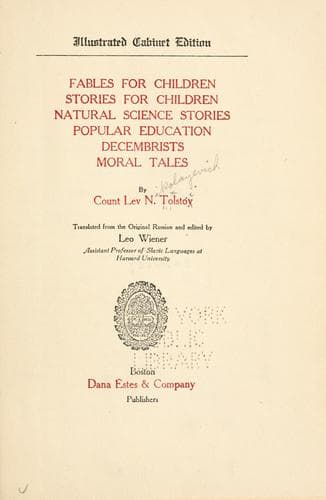
Fables for Children, Stories for Children, Natural Science Stories, Popular Education, Decembrists, Moral TalesTolstoy, Leo, graf
General
Fables for Children, Stories for Children, Natural Science Stories, Popular Education, Decembrists, Moral Tales
Tolstoy, Leo, graf
Russian literature -- Translations into English
In the popular school the right to determine what the children shall
learn, no matter from what standpoint we may consider this question,
belongs just as much to the masses, that is, either to the pupils
themselves, or to the parents who send the children to school, and so
the answer to the question what the children are to be taught in a
popular school can be got only from the masses. But, perhaps, we shall
say that we, as highly cultured people, must not submit to the demands
of the rude masses and that we must teach the masses what to wish. Thus
many think, but to that I can give this one answer: give us a firm,
incontrovertible foundation why this or that is chosen by you, show me a
society in which the two diametrically opposed views on education do not
exist among the highly cultured people; where it is not eternally
repeated that if education falls into the hands of the clergy, the
masses are educated in one sense, and if education falls into the hands
of the progressists, the people are educated in another sense,--show me
a state of society where that does not exist, and I will agree with you.
So long as that does not exist, there is no criterion except the freedom
of the learner, where, in matters of the popular school, the place of
the learning children is taken by their parents, that is, by the needs
of the masses.
These needs are not only definite, quite clear, and everywhere the same
throughout Russia, but also so intelligent and broad that they include
all the most diversified demands of the people who are debating what the
masses ought to be taught. These needs are: the knowledge of Russian and
Church-Slavic reading, and calculation. The masses everywhere and always
regard the natural sciences as useless trifles. Their programme is
remarkable not only by its unanimity and firm definiteness, but, in my
opinion, also by the breadth of its demands and the correctness of its
view. The masses admit two spheres of knowledge, the most exact and the
least subject to vacillation from a diversity of views,--the languages
and mathematics; everything else they regard as trifles. I think that
the masses are quite correct,--in the first place, because in this
knowledge there can be no half information, no falseness, which they
cannot bear, and, in the second, because the sphere of those two kinds
of knowledge is immense. Russian and Church-Slavic grammar and
calculation, that is, the knowledge of one dead and one living language,
with their etymological and syntactical forms and their literatures, and
arithmetic, that is, the foundation of all mathematics, form their
programme of knowledge, which, unfortunately, but the rarest of the
cultured class possess. In the third place, the masses are right,
because by this programme they will be taught in the primary school only
what will open to them the more advanced paths of knowledge, for it is
evident that the thorough knowledge of two languages and their forms,
Public-domain text, read in full here on John Shaqi.
Reviews
Reviews
No reviews yet
Be the first to share your thoughts on this work.
Elsewhere in the archive
Join the Discussion
Join the discussion
Sign in to leave a comment or review.
Sign InorCreate an account