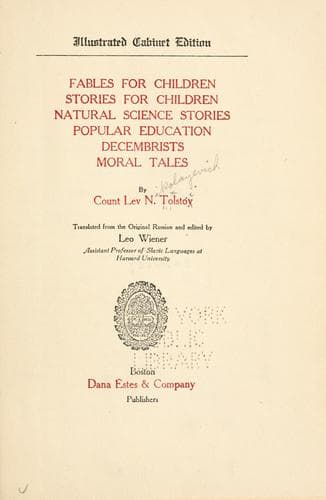
Fables for Children, Stories for Children, Natural Science Stories, Popular Education, Decembrists, Moral TalesTolstoy, Leo, graf
General
Fables for Children, Stories for Children, Natural Science Stories, Popular Education, Decembrists, Moral Tales
Tolstoy, Leo, graf
Russian literature -- Translations into English
Education and instruction are generally considered in the abstract, that
is, the question is discussed how in the best and easiest manner to
produce a certain act of instruction on a certain subject (whether it be
one child or a mass of children). This view is quite faulty. All
education and instruction can be viewed only as a certain relation of
two persons or of two groups of persons having for their aim education
or instruction. This definition, more general than all the other
definitions, has special reference to popular education, where the
question is the education of an immense number of persons, and where
there can be no question about an ideal education. In general, with the
popular education we cannot put the question, "How is the best education
to be given?" just as with the question of the nutrition of the masses
we cannot ask how the most nutritious and best loaf is to be baked. The
question has to be put like this: "How is the best relation to be
established between given people who want to learn and others who want
to teach?" or, "How is the best bread to be made from given bolted
flour?" Consequently the question of how to teach and what is the best
method is a question of what will be the best relation between teacher
and pupil.
Nobody, I suppose, will deny that the best relation between teacher and
pupil is that of naturalness, and that the contrary relation is that of
compulsion. If so, the measure of all methods is to be found in the
greater or lesser naturalness of relations and, therefore, in the lesser
or greater compulsion in instruction. The less the children are
compelled to learn, the better is the method; the more--the worse. I am
glad that I do not have to prove this evident truth. Everybody is agreed
that just as in hygiene the use of any food, medicine, exercise, that
provokes loathing or pain, cannot be useful, so also in instruction can
there be no necessity of compelling children to learn anything that is
tiresome and repulsive to them, and that, if necessity demands that
children be compelled, it only proves the imperfection of the method.
Any one who has taught children has no doubt observed that the less the
teacher himself knows the subject which he teaches and the less he likes
it, the more will he have to have recourse to severity and compulsion;
on the contrary, the more the teacher knows and loves his subject, the
more natural and easy will his instruction be. With the idea that for
successful instruction not compulsion is wanted, but the rousing of the
pupil's interest, all the pedagogues of the school which is opposed to
me agree. The only difference between us is that the conception that the
teaching must rouse the child's interest is with them lost in a mass of
other conflicting notions about "development," of the value of which
they are convinced and in which they exercise compulsion; whereas I
consider the rousing of the pupil's interest, the greatest possible
Public-domain text, read in full here on John Shaqi.
Reviews
Reviews
No reviews yet
Be the first to share your thoughts on this work.
Elsewhere in the archive
Join the Discussion
Join the discussion
Sign in to leave a comment or review.
Sign InorCreate an account