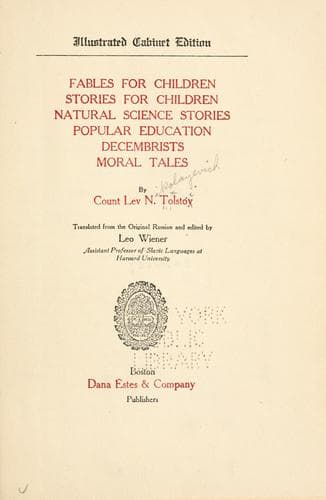
Fables for Children, Stories for Children, Natural Science Stories, Popular Education, Decembrists, Moral TalesTolstoy, Leo, graf
General
Fables for Children, Stories for Children, Natural Science Stories, Popular Education, Decembrists, Moral Tales
Tolstoy, Leo, graf
Russian literature -- Translations into English
and, in addition to them, of arithmetic, completely opens the paths to
an independent acquisition of all other knowledge. The masses, as though
feeling the false relation to them, when they are offered incoherent
scraps of all kinds of information, repel that lie from themselves, and
say: "I need know but this much,--the church language and my own and the
laws of the numbers, but that other knowledge I will take myself if I
want it."
Thus, if we admit freedom as the criterion of what is to be taught, the
programme of the popular schools is clearly and firmly defined, until
the time when the masses shall express some new demands. Church-Slavic
and Russian and arithmetic to their highest possible stages, and nothing
else but that. That is the determination of the limits of the programme
of the popular school, which, however, does not presume that all three
subjects be introduced systematically. With such a programme the
attainment of symmetrical results in all three subjects would naturally
be desirable; but it cannot be said that the predominance of one subject
over another would be injurious. The problem consists only in keeping
within the limits of the programme. It may happen that from the demands
of the parents, and especially from the knowledge of the teacher, this
or that subject will be more prominent,--with a clerical person the
Church-Slavic language, with a teacher from a county school--either
Russian or arithmetic; in all these cases the demands of the masses will
be satisfied, and the instruction will not depart from its fundamental
criterion.
The second part of the question, how to teach, that is, how to discover
which method is the best, has remained just as unsolved.
Just as in the first part of the question of what to teach, the
assumption that on the basis of reflections it is possible to build a
programme of instruction leads to contradictory schools, so it is also
with the question as to how to teach. Let us take the very first
stage of the teaching of reading. One asserts that it is easier to
teach so from cards; another--according to the _b_, _v_ system; a
third--according to Korf; a fourth--according to the _be_, _ve_, _ge_
system, and so forth. It is said that the nuns teach reading in six
weeks by the _buki-az_--_ba_ system. And every teacher, convinced of the
superiority of his method, proves this superiority either by the fact
that he teaches with it faster than others, or by reflections of the
character which Mr. Bunákov and the German pedagogues adduce. At the
present time, when there are thousands of examples, we ought to know
precisely by what to be guided in our choice. Neither theory, nor
reflections, nor even the results of instruction can show this
completely.
Public-domain text, read in full here on John Shaqi.
Reviews
Reviews
No reviews yet
Be the first to share your thoughts on this work.
Elsewhere in the archive
Join the Discussion
Join the discussion
Sign in to leave a comment or review.
Sign InorCreate an account