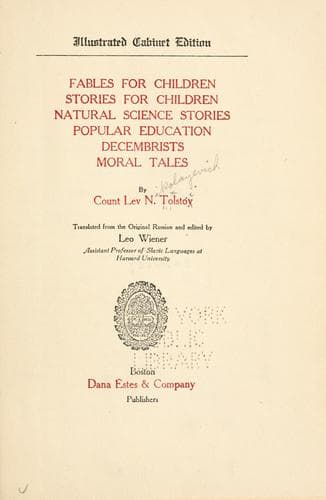
Fables for Children, Stories for Children, Natural Science Stories, Popular Education, Decembrists, Moral TalesTolstoy, Leo, graf
General
Fables for Children, Stories for Children, Natural Science Stories, Popular Education, Decembrists, Moral Tales
Tolstoy, Leo, graf
Russian literature -- Translations into English
This discord between the demands of pedagogy and reality has of late
found its peculiarly striking expression not only in the matter of
instruction itself, but also in another very important side of the
school, namely in its administration. In order to show in what condition
this matter has been and might be, I shall speak of Krapívensk County of
the Government of Túla, in which I live, which I know, and which, from
its position, forms the type of the majority of counties of central
Russia.
In 1862 fourteen schools were opened in a district of ten thousand
souls, when I was rural judge; besides, there existed about ten schools
in the district among the clericals and in the manors among the
servants. In the three remaining districts of the county there were
fifteen large and thirty small schools among the clericals and manorial
servants. Without saying anything about the number of the learners, of
which, I assume, there were in general not less than now, nor about the
instruction itself, which was partly bad and partly good, but on the
whole not worse than at present, I will tell how and on what that
business was based.
All schools were then, with few exceptions, based on a free agreement of
the teacher with the parents of the pupils, or with the whole
partnership of the peasants paying a lump sum for everybody. Such a
relation between the parents or Communes and the teachers is even now
met with in some exceedingly rare places of our county and of the
Government in general. Everybody will agree that, leaving aside the
question of the quality of instruction, such a relation of the teacher
to the parents and peasants is most just, natural, and desirable. But,
with the introduction of the law of 1864, this relation was abolished
and is being abolished more and more. Everybody who knows the matter as
it is will observe that with the abolition of this relation the people
take less and less part in the matter of their education, which is only
natural. In some County Councils the school tax of the peasants is even
turned into the County Council, and the salary, appointment of teachers,
location of schools,--all that is done quite independently of those for
whom it is intended (in theory the peasants, no doubt, are members of
the County Council, but in practice they have through this mediation no
influence on their own schools). Nobody will, I suppose, assert that
that is just, but some will say: "The illiterate peasants cannot judge
what is good and what bad, and we must build for them as well as we
can." But how do we know? Do we know firmly, are we all of one opinion,
how to build schools? And does it not frequently turn out bad, for we
have built much worse than they have?
Public-domain text, read in full here on John Shaqi.
Reviews
Reviews
No reviews yet
Be the first to share your thoughts on this work.
Elsewhere in the archive
Join the Discussion
Join the discussion
Sign in to leave a comment or review.
Sign InorCreate an account