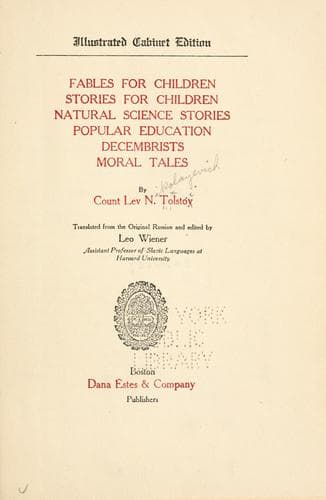
Fables for Children, Stories for Children, Natural Science Stories, Popular Education, Decembrists, Moral TalesTolstoy, Leo, graf
General
Fables for Children, Stories for Children, Natural Science Stories, Popular Education, Decembrists, Moral Tales
Tolstoy, Leo, graf
Russian literature -- Translations into English
Thus, in relation to the administrative side of the schools I have again
to put a third question, on the same basis of freedom: Why do we know
how best to arrange a school? To this question German pedagogy gives an
answer which is quite consistent with its whole system. It knows what
the best school is, it has formed a clear, definite ideal, down to the
minutest details, the benches, the hours of instruction, and so forth,
and gives an answer: the school has to be such and such, according to
this pattern,--this alone is good and every other school is injurious. I
know that, although the desire of Henry IV. to give each Frenchman soup
and a chicken was unrealizable, it was impossible to say that the desire
was false. But the matter assumes an entirely different aspect when the
soup is of a very questionable quality and is not a chicken soup, but a
worthless broth. And yet the so-called science of pedagogy is in this
matter indissolubly connected with power; both in Germany and with us
there are prescribed certain ideal one-class, two-class schools, and so
forth; and the pedagogical and the administrative powers do not wish to
know the fact that the masses would like to attend to their own
education. Let us see how such a view of popular education has been
reflected in practice on the question of education.
Beginning with the year 1862 the idea that education was necessary has
more and more spread among the masses: on all sides schools were
established by church servants, hired teachers, and the Communes.
Whether good or bad, these schools were spontaneous and grew out
directly from the needs of the masses; with the introduction of the law
of 1864 this tendency was increased, and in 1870 there were, according
to the reports, about sixty schools in Krapívensk County. Since then
officials of the ministry and members of the County Council have begun
to meddle more and more with school matters, and in Krapívensk County
forty schools have been closed and schools of a lower order have been
prohibited from being opened. I know that those who closed those schools
affirm that these schools existed only nominally and were very bad; but
I cannot believe it, because I know well-instructed pupils from three
villages, Trósna, Lamíntsovo, and Yásnaya Polyána, where schools were
closed. I also know—-and this will seem incredible to many—-what is
meant by prohibiting the opening of schools. It means that, on the basis
of a circular of the ministry of public instruction, which spoke of the
prohibition of unreliable teachers (this, no doubt, had reference to the
Nihilists), the school council transferred this prohibition to the minor
schools, taught by sextons, soldiers, and so forth, which the peasants
themselves had opened, and which, no doubt, are not at all comprised in
the circular. But, instead, there exist twenty schools with teachers,
who are supposed to be good because they receive a salary of two hundred
Public-domain text, read in full here on John Shaqi.
Reviews
Reviews
No reviews yet
Be the first to share your thoughts on this work.
Elsewhere in the archive
Join the Discussion
Join the discussion
Sign in to leave a comment or review.
Sign InorCreate an account