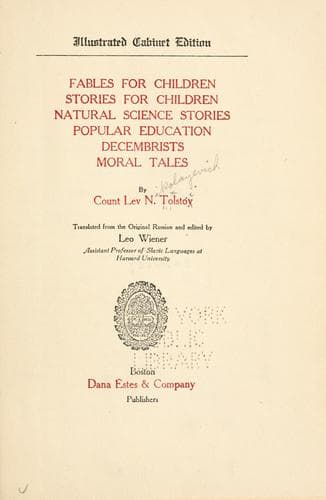
Fables for Children, Stories for Children, Natural Science Stories, Popular Education, Decembrists, Moral TalesTolstoy, Leo, graf
General
Fables for Children, Stories for Children, Natural Science Stories, Popular Education, Decembrists, Moral Tales
Tolstoy, Leo, graf
Russian literature -- Translations into English
Thus, the chief distinctions between the administrative view of the
masses and that of the County Council are the following: (1) the County
Council pays great attention to the housing and spends large sums upon
it, while the masses obviate this difficulty by domestic, economic
means, and look upon the primary schools as temporary, passing
institutions; (2) the ministerial department demands that instruction be
carried on during the whole year, with the exception of July and August,
and nowhere introduces evening classes, while the masses demand that
instruction be carried on only in the winter and are fond of evening
classes; (3) the ministerial department has a definite type of teachers,
without which it does not recognize the school, and has a loathing for
clerical persons and, in general, for local instructors; the masses
recognize no norm and choose their teachers preferably from local
inhabitants; (4) the ministerial department distributes the schools by
accident, that is, it is guided only by the desire of forming a normal
school, and has no care for that greater half of the population which
under such a distribution is left outside the school education; the
masses not only recognize no definite external form of the school, but
in the greatest variety of ways get teachers with all kinds of means,
arranging worse and cheaper schools with small means and good and
expensive schools with greater means, and turn their attention to
furnishing all localities with instruction in return for their money;
(5) the ministerial department determines one measure of remuneration,
which is sufficiently high, and arbitrarily increases the amount from
the County Council; the masses demand the greatest possible economy and
distribute the remuneration in such a way that those whose children are
taught pay directly.
It seems as though it would be superfluous to expatiate on how clearly
the common sense of the masses is expressed in these demands, in
contradistinction to that artificial structure, in which, at its very
birth, they are trying to imprison the business of popular education.
Even besides this, the feeling of justice is involuntarily provoked
against such an order of things. See what is taking place. The masses
have felt the necessity of education, and have begun to work in the
direction of attaining their end. In addition to all the taxes which
they pay, they have voluntarily imposed upon themselves the tax for
education, that is, they have begun to hire teachers. What have we done?
"Oh, you are able to pay," we said, "wait, then, for you are stupid and
rude. Let us have the money, and we will arrange it for you in the best
manner possible."
The masses have given up their money (as I have said, in many County
Councils the levy for the schools has been turned directly into a tax).
The money was taken, and the education was arranged for them.
Public-domain text, read in full here on John Shaqi.
Reviews
Reviews
No reviews yet
Be the first to share your thoughts on this work.
Elsewhere in the archive
Join the Discussion
Join the discussion
Sign in to leave a comment or review.
Sign InorCreate an account