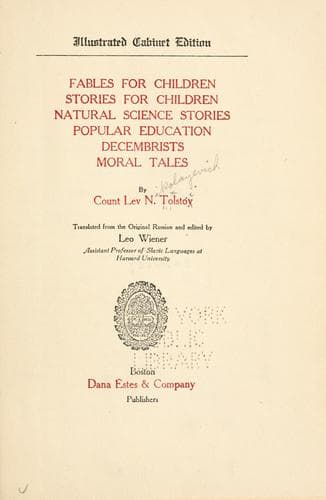
Fables for Children, Stories for Children, Natural Science Stories, Popular Education, Decembrists, Moral TalesTolstoy, Leo, graf
General
Fables for Children, Stories for Children, Natural Science Stories, Popular Education, Decembrists, Moral Tales
Tolstoy, Leo, graf
Russian literature -- Translations into English
Naturally the organization of these teachers' meetings, both for the
smaller and the larger schools, and the head teacher's visits of
inspection, and the formation of teachers from pupils acting as
assistants may take place in a large variety of ways; the main point is
that the surveillance of any number of schools (even though it may reach
the norm of one school to every one hundred souls) is possible in this
manner. With such an arrangement the teachers of both the large and the
small schools will feel that their labours are appreciated, that they
have not buried themselves in the backwoods without hope of salvation,
that they have companions and guides, and that in the matter of
instruction, both for their own further education and for the
improvement of their situation, they have means for advancement. With
such an arrangement, the devotee and the sexton who are able to learn
will learn; while those who are unable or unwilling to do so will be
replaced by some one else.
The time of instruction ought to be, as is the wish of all peasants,
during the seven winter months, and so the salary is to be determined by
the month. With such an arrangement, leaving out the rapidity and the
equal distribution of education, the advantage will be this, that the
schools will be established in those centres where the necessity for
them is felt by the masses, where they are established spontaneously
and, therefore, firmly. Where the character of the population demands
education it will be permanent. Just look: in the towns, the children of
the innkeepers and well-to-do peasants learn to read in one way or
another and never forget what they have learned; but in the backwoods,
where a landed proprietor founds a school, the children learn well, but
in ten years all is forgotten, and the population is as illiterate as
ever. For this reason the centres, large or small, where the schools are
established spontaneously, are particularly precious. Where such a
school has germinated, no matter how poor it be, it will throw out
roots, and sooner or later the population will be able to read and
write. Consequently, these sprouts ought to be deemed precious, and not
be treated, as they are everywhere,--they ought not to be forbidden,
because the schools are not according to our taste, that is, the sprouts
ought not to be killed, and branches stuck in the ground where they will
not take root.
Public-domain text, read in full here on John Shaqi.
Reviews
Reviews
No reviews yet
Be the first to share your thoughts on this work.
Elsewhere in the archive
Join the Discussion
Join the discussion
Sign in to leave a comment or review.
Sign InorCreate an account