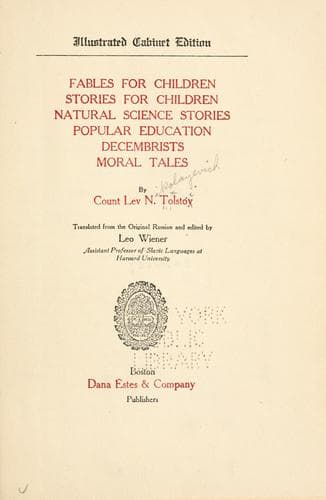
Fables for Children, Stories for Children, Natural Science Stories, Popular Education, Decembrists, Moral TalesTolstoy, Leo, graf
General
Fables for Children, Stories for Children, Natural Science Stories, Popular Education, Decembrists, Moral Tales
Tolstoy, Leo, graf
Russian literature -- Translations into English
With merely such an arrangement, without the establishment of costly and
artificial seminaries, the chosen ones--those selected from the best of
the pupils themselves, and those who are educated in the schools--will
form that contingent of cheap popular teachers who will take the place
of the soldiers and sextons and will fully satisfy all the demands of
the masses and of the educated classes. The chief advantage of such an
arrangement is that it alone gives the development of popular education
a future, that is, takes us out from that blind alley into which the
County Councils have gone, thanks to the expensive schools and to the
absence of new sources for the increase of their numbers. Only when the
masses themselves choose the centres for the schools, themselves choose
teachers, determine the amount of the remuneration, and directly enjoy
the advantages of the schools, will they be ready to add means for the
schools if such should become necessary. I know Communes that paid fifty
kopeks a soul for a school in each of their villages; but it is
difficult to compel the peasants to pay fifteen kopeks for a school in
the township, if not all of them can make use of it. For the whole
county, for the County Council, the peasants will not add a single
kopek, because they feel that they will not enjoy the advantages of
their money. Only with such an arrangement will be found soon the means
for the proper maintenance of all schools, of one to each one hundred
souls, which seems so impossible in the present state of affairs.
In addition to this, with the arrangement which I propose, the interests
of the peasant Communes and of the County Council, as the representative
of the intelligence of the locality, will indissolubly be connected. Let
us say that the County Council gives one-third of what the peasants
give. In furnishing this amount, it will evidently, in one way or
another, see to it that the money is not wasted, and, consequently, will
also keep an eye on the two-thirds given by the peasant Communes. The
peasant Commune sees that the County Council gives its part, and so
admits the right of the Council to follow the progress of the
instruction. At the same time, it has an object-lesson in the difference
which exists between a school maintained at a smaller and that
maintained at a greater expense, and chooses the one which it needs or
which is more accessible to it in accordance with its means.
Public-domain text, read in full here on John Shaqi.
Reviews
Reviews
No reviews yet
Be the first to share your thoughts on this work.
Elsewhere in the archive
Join the Discussion
Join the discussion
Sign in to leave a comment or review.
Sign InorCreate an account