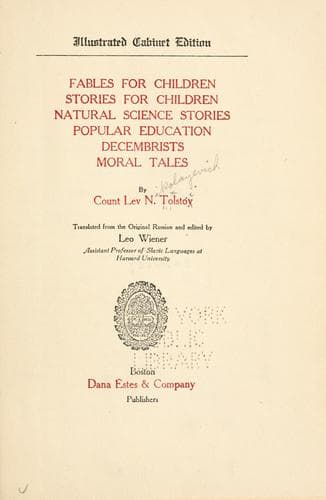
Fables for Children, Stories for Children, Natural Science Stories, Popular Education, Decembrists, Moral TalesTolstoy, Leo, graf
General
Fables for Children, Stories for Children, Natural Science Stories, Popular Education, Decembrists, Moral Tales
Tolstoy, Leo, graf
Russian literature -- Translations into English
Love is of God; and every one that loveth is born of God, and
knoweth God. (_Ib._ iv. 7.)
He that loveth not knoweth not God; for God is love. (_Ib._ iv. 8.)
No man hath seen God at any time. If we love one another, God
dwelleth in us. (_Ib._ iv. 12.)
God is love; and he that dwelleth in love dwelleth in God, and God
in him. (_Ib._ iv. 16.)
If a man say, I love God, and hateth his brother, he is a liar: for
he that loveth not his brother whom he hath seen, how can he love
God whom he hath not seen. (_Ib._ iv. 20.)
I.
A shoemaker was lodging with his wife and children at the house of a
peasant. He had no house, no land of his own, and supported his family
by his shoemaker's trade. Bread was dear, but work was cheap, and he
spent everything he made. The shoemaker and his wife had one fur coat
between them, and even that was all worn to tatters; this was the second
year that the shoemaker had been meaning to buy a sheepskin for a new
fur coat.
Toward fall the shoemaker had saved some money: three roubles in paper
lay in his wife's coffer, and five roubles and twenty kopeks were
outstanding in the village.
In the morning the shoemaker went to the village to get him that fur
coat. He put on his wife's wadded nankeen jacket over his shirt, and
over it his cloth caftan; he put the three-rouble bill into his pocket,
broke off a stick, and started after breakfast. He thought:
"I shall get the five roubles from the peasant, will add my own three,
and with that will buy me a sheepskin for the fur coat."
The shoemaker came to the village, and called on the peasant: he was not
at home, and his wife promised to send her husband with the money, but
gave him none herself. He went to another peasant, but the peasant swore
that he had no money, and gave him only twenty kopeks for mending a pair
of boots. The shoemaker made up his mind to take the sheepskin on
credit, but the furrier would not give it to him.
"Bring me the money," he said, "and then you can choose any you please;
we know what it means to collect debts."
Thus the shoemaker accomplished nothing. All he got was the twenty
kopeks for the boots he had mended, and a peasant gave him a pair of
felt boots to patch with leather.
The shoemaker was grieved, spent all the twenty kopeks on vódka, and
started home without the fur coat. In the morning it had seemed frosty
to him, but now that he had drunk a little he felt warm even without the
fur coat. The shoemaker walked along, with one hand striking the stick
against the frozen mud clumps, and swinging the felt boots in the other,
and talking to himself.
Public-domain text, read in full here on John Shaqi.
Reviews
Reviews
No reviews yet
Be the first to share your thoughts on this work.
Elsewhere in the archive
Join the Discussion
Join the discussion
Sign in to leave a comment or review.
Sign InorCreate an account