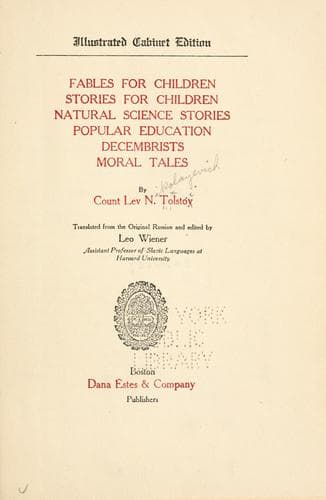
Fables for Children, Stories for Children, Natural Science Stories, Popular Education, Decembrists, Moral TalesTolstoy, Leo, graf
General
Fables for Children, Stories for Children, Natural Science Stories, Popular Education, Decembrists, Moral Tales
Tolstoy, Leo, graf
Russian literature -- Translations into English
"I am warm even without a fur coat," he said. "I have drunk a cup, and
the vódka is coursing through all my veins. I do not need a sheepskin.
I have forgotten my woe. That's the kind of a man I am! What do I care!
I can get along without a fur coat: I do not need it all the time. The
only trouble is the old woman will be sorry. It is a shame indeed: I
work for him, and he leads me by the nose. Just wait! If you do not
bring the money, I'll take away your cap, upon my word, I will! How is
this? He pays me back two dimes at a time! What can you do with two
dimes? Take a drink, that is all. He says he suffers want. You suffer
want, and am I not suffering? You have a house, and cattle, and
everything, and here is all I possess; you have your own grain, and I
have to buy it. I may do as I please, but I have to spend three roubles
a week on bread. I come home, and the bread is gone: again lay out a
rouble and a half! So give me what is mine!"
Thus the shoemaker came up to a chapel at the turn of the road, and
there he saw something that looked white, right near the chapel. It was
growing dusk, and the shoemaker strained his eyes, but could not make
out what it was.
"There was no stone here," he thought. "A cow? It does not look like a
cow. It looks like the head of a man, and there is something white
besides. And what should a man be doing there?"
He came nearer, and he could see plainly. What marvel was that? It was
really a man, either alive or dead, sitting there all naked, leaning
against the chapel, and not stirring in the least. The shoemaker was
frightened, and thought to himself:
"Somebody must have killed a man, and stripped him of his clothes, and
thrown him away there. If I go up to him, I shall never clear myself."
And the shoemaker went past. He walked around the chapel, and the man
was no longer to be seen. He went past the chapel, and looked back, and
saw the man leaning away from the building and moving, as though
watching him. The shoemaker was frightened even more than before, and he
thought to himself:
"Shall I go up to him, or not? If I go up, something bad may happen. Who
knows what kind of a man he is? He did not get there for anything good.
If I go up, he will spring at me and choke me, and I shall not get away
from him; and if he does not choke me, I may have trouble with him all
the same. What can I do with him, since he is naked? Certainly I cannot
take off the last from me and give it to him! May God save me!"
And the shoemaker increased his steps. He was already a distance away
from the chapel, when his conscience began to smite him.
And the shoemaker stopped on the road.
"What are you doing, Semén?" he said to himself. "A man is dying in
misery, and you go past him and lose your courage. Have you suddenly
grown so rich? Are you afraid that they will rob you of your wealth? Oh,
Semén, it is not right!"
Semén turned back, and went up to the man.
II.
Public-domain text, read in full here on John Shaqi.
Reviews
Reviews
No reviews yet
Be the first to share your thoughts on this work.
Elsewhere in the archive
Join the Discussion
Join the discussion
Sign in to leave a comment or review.
Sign InorCreate an account