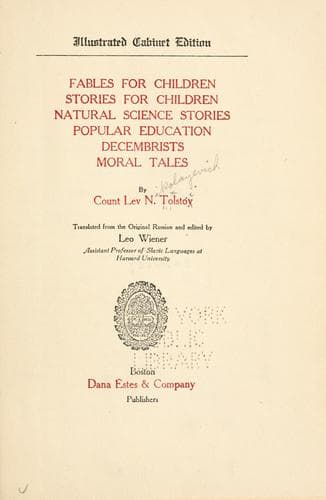
Fables for Children, Stories for Children, Natural Science Stories, Popular Education, Decembrists, Moral TalesTolstoy, Leo, graf
General
Fables for Children, Stories for Children, Natural Science Stories, Popular Education, Decembrists, Moral Tales
Tolstoy, Leo, graf
Russian literature -- Translations into English
"He said nothing. When he saw me, he greeted me and at once began to
sing again."
"What did you say to him?"
"I did not say anything to him, but the peasants came up and laughed at
him: 'Mikhyéev will not get rid of his sin of ploughing during Easter
week even if he should pray all his life.'"
"What did he say to that?"
"All he said was: 'Peace on earth and good-will to men.' He took his
plough, started his horses, and sang out in a thin voice, but the candle
kept burning and did not go out."
The clerk stopped laughing. He put down the guitar, lowered his head,
and fell to musing.
He sat awhile; then he sent away the cook and the elder, went behind the
curtain, lay down on the bed, and began to sigh and to sob, just as
though a cart were driving past with sheaves. His wife came and began to
speak to him; he gave her no answer. All he said was:
"He has vanquished me. My turn has come."
His wife tried to calm him.
"Go and send them home! Maybe it will be all right. See what deeds you
have done, and now you lose your courage."
"I am lost," he said. "He has vanquished me."
His wife cried to him:
"You just have it on your brain, 'He has vanquished me, he has
vanquished me.' Go and send the peasants home, and all will be well. Go,
and I will have your horse saddled."
The horse was brought up, and the clerk's wife persuaded him to ride
into the field to send the peasants home.
Mikhaíl Seménovich mounted his horse and rode into the field. He drove
through the yard, and a woman opened the gate for him, and he passed
into the village. The moment the people saw the clerk, they hid
themselves from him, one in the yard, another around a corner, a third
in the garden.
The clerk rode through the whole village and reached the outer gate. The
gate was shut, and he could not open it while sitting on his horse. He
called and called for somebody to open the gate, but no one would come.
He got down from his horse, opened the gate, and in the gateway started
to mount again. He put his foot into the stirrup, rose in it, and was on
the point of vaulting over the saddle, when his horse shied at a pig and
backed up toward the picket fence; he was a heavy man and did not get
into his saddle, but fell over, with his belly on picket. There was but
one sharp post in the picket fence, and it was higher than the rest. It
was this post that he struck with his belly. He was ripped open and fell
to the ground.
When the peasants drove home from their work, the horses snorted and
would not go through the gate. The peasants went to look, and saw
Mikhaíl lying on his back. His arms were stretched out, his eyes stood
open, and all his inside had run out and the blood stood in a pool,--the
earth had not sucked it in.
Public-domain text, read in full here on John Shaqi.
Reviews
Reviews
No reviews yet
Be the first to share your thoughts on this work.
Elsewhere in the archive
Join the Discussion
Join the discussion
Sign in to leave a comment or review.
Sign InorCreate an account