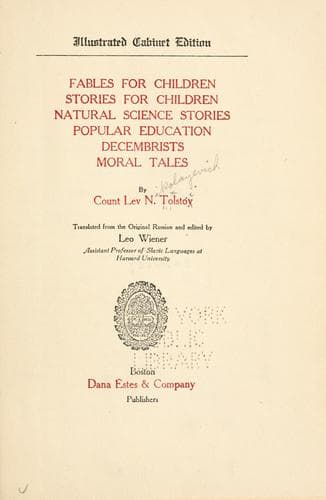
Fables for Children, Stories for Children, Natural Science Stories, Popular Education, Decembrists, Moral TalesTolstoy, Leo, graf
General
Fables for Children, Stories for Children, Natural Science Stories, Popular Education, Decembrists, Moral Tales
Tolstoy, Leo, graf
Russian literature -- Translations into English
The peasants were frightened. They took their horses in by back roads,
but Mikhyéev alone got down and walked over to the clerk. He saw that he
was dead, so he closed his eyes, hitched his cart, with the aid of his
son put the dead man in the bed of the cart, and took him to the manor.
The master heard about all these things, and to save himself from sin
substituted tenant pay for the manorial labour.
And the peasants saw that the power of God was not in sin, but in
goodness.
THE TWO OLD MEN
1885
THE TWO OLD MEN
Therefore, being wearied with his journey, sat thus on the well:
and it was about the sixth hour. There cometh a woman of Samaria to
draw water: Jesus saith unto her, Give me to drink. (For his
disciples were gone away unto the city to buy meat.) Then saith the
woman of Samaria unto him, How is it that thou, being a Jew, askest
drink of me, which am a woman of Samaria? for the Jews have no
dealings with the Samaritans. Jesus answered and said unto her, If
thou knewest the gift of God, and who it is that saith to thee,
Give me to drink; thou wouldest have asked of him, for the Father
seeketh such to worship him. (John iv. 19-23.)
I.
Two old men got ready to go to old Jerusalem to pray to God. One of them
was a rich peasant; his name was Efím Tarásych Shevelév. The other was
not a well-to-do man, and his name was Eliséy Bodróv.
Efím was a steady man: he did not drink liquor, nor smoke tobacco, nor
take snuff, had never cursed in his life, and was a stern, firm old man.
He had served two terms as an elder, and had gone out of his office
without a deficit. He had a large family,--two sons and a married
grandson,--and all lived together. As to looks he was a sound, bearded,
erect man, and only in his seventh decade did a gray streak appear in
his beard.
Eliséy was neither wealthy nor poor; in former days he used to work out
as a carpenter, but in his old age he stayed at home and kept bees. One
son was away earning money, and another was living at home. Eliséy was a
good-natured and merry man. He liked to drink liquor and take snuff, and
sing songs; but he was a peaceable man, and lived in friendship with his
home folk and with the neighbours. In appearance he was an undersized,
swarthy man, with a curly beard and, like his saint, Prophet Elisha, his
whole head was bald.
The old men had long ago made the vow and agreed to go together, but
Tarásych had had no time before: he had so much business on hand. The
moment one thing came to an end, another began; now he had to get his
grandson married, now he was expecting his younger son back from the
army, and now he had to build him a new hut.
On a holiday the two old men once met, and they sat down on logs.
"Well," said Eliséy, "when are we going to carry out our vow?"
Efím frowned.
Public-domain text, read in full here on John Shaqi.
Reviews
Reviews
No reviews yet
Be the first to share your thoughts on this work.
Elsewhere in the archive
Join the Discussion
Join the discussion
Sign in to leave a comment or review.
Sign InorCreate an account