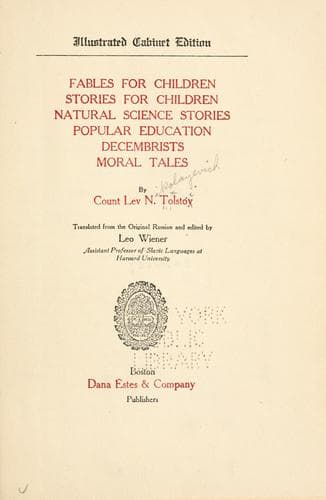
Fables for Children, Stories for Children, Natural Science Stories, Popular Education, Decembrists, Moral TalesTolstoy, Leo, graf
General
Fables for Children, Stories for Children, Natural Science Stories, Popular Education, Decembrists, Moral Tales
Tolstoy, Leo, graf
Russian literature -- Translations into English
"We lived heretofore poorly," they said, "but when the crop failed us,
we ate up in the fall everything we had. When we had nothing left, we
began to beg from our neighbours and from good people. At first they
gave us some, but later they refused. Some of them would have been
willing to give us to eat, but they had nothing themselves. Besides we
felt ashamed to beg: we owed everybody money and flour and bread. I
looked for work," said the man, "but could find none. People were
everywhere looking for work to get something to eat. One day I would
work, and two I would go around looking for more work. The old woman and
the girl went a distance away to beg, but the alms were poor,--nobody
had any bread. Still, we managed to get something to eat: we thought we
might squeeze through until the new crop; but in the spring they quit
giving us alms altogether, and sickness fell upon us. It grew pretty
bad: one day we would have something to eat, and two we went without it.
We began to eat grass. And from the grass, or from some other reason,
the woman grew sick. She lay down, and I had no strength, and we had
nothing with which to improve matters."
"I was the only one," the old woman said, "who worked: but I gave out
and grew weak, as I had nothing to eat. The girl, too, grew weak and
lost her courage. I sent her to the neighbours, but she did not go. She
hid herself in a corner and would not go. A neighbour came in two days
ago, but when she saw that we were hungry and sick, she turned around
and went out. Her husband has left, and she has nothing with which to
feed her young children. So we were lying here and waiting for death."
When Eliséy heard what they said, he changed his mind about catching up
with his companion, and remained there overnight. In the morning Eliséy
got up and began to work about the house as though he were the master.
He set bread with the old woman and made a fire in the oven. He went
with the girl to the neighbours to fetch what was necessary. Everything
he wanted to pick up was gone: there was nothing left for farming, and
the clothes were used up. Eliséy got everything which was needed: some
things he made himself, and some he bought. Eliséy stayed with them one
day, and a second, and a third. The little boy regained his strength,
and he began to walk on the bench and to make friends with Eliséy. The
girl, too, became quite cheerful and helped him in everything. She kept
running after Eliséy: "Grandfather, grandfather!"
The old woman got up and went to her neighbour. The man began to walk by
holding on to the wall. Only the woman was lying down. On the third day
she came to and asked for something to eat.
"Well," thought Eliséy, "I had not expected to lose so much time. Now I
must go."
VI.
The fourth day was the last of a fast, and Eliséy said to himself:
"I will break fast with them. I will buy something for them for the
holidays, and in the evening I must leave."
Public-domain text, read in full here on John Shaqi.
Reviews
Reviews
No reviews yet
Be the first to share your thoughts on this work.
Elsewhere in the archive
Join the Discussion
Join the discussion
Sign in to leave a comment or review.
Sign InorCreate an account