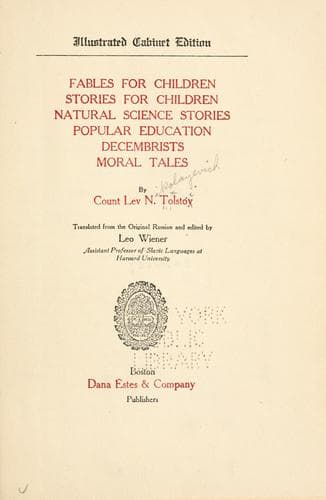
Fables for Children, Stories for Children, Natural Science Stories, Popular Education, Decembrists, Moral TalesTolstoy, Leo, graf
General
Fables for Children, Stories for Children, Natural Science Stories, Popular Education, Decembrists, Moral Tales
Tolstoy, Leo, graf
Russian literature -- Translations into English
Eliséy went once more to the village and bought milk, white flour, and
lard. He and the old woman cooked and baked a lot of things, and in the
morning Eliséy went to mass and came back and broke fast with the
people. On that day the woman got up and began to move about. The man
shaved himself, put on a clean shirt,--the old woman had washed it for
him,--and went to a rich peasant to ask a favour of him. His mowing and
field were mortgaged to the rich man, so he went to ask him to let him
have the mowing and the field until the new crop. He came back gloomy in
the evening, and burst out weeping. The rich man would not show him the
favour; he had asked him to bring the money.
Eliséy fell to musing.
"How are they going to live now? People will be going out to mow, but
they cannot go, for it is all mortgaged. The rye will ripen and people
will begin to harvest it (and there is such a fine stand of it!), but
they have nothing to look forward to,--their desyatína is sold to the
rich peasant. If I go away, they will fall back into poverty."
And Eliséy was in doubt, and did not go away in the evening, but put it
off until morning. He went into the yard to sleep. He said his prayers
and lay down, but could not fall asleep.
"I ought to go,--as it is I have spent much time and money; but I am
sorry for the people. You can't help everybody. I meant to bring them
some water and give each a slice of bread, but see how far I have gone.
Now I shall have to buy out his mowing and field. And if I buy out the
field, I might as well buy a cow for the children, and a horse for the
man to haul his sheaves with. Brother Eliséy Kuzmích, you are in for it!
You have let yourself loose, and now you will not straighten out
things."
Eliséy got up, took the caftan from under his head, and unrolled it; he
drew out his snuff-horn and took a pinch, thinking that he would clear
his thoughts, but no,--he thought and thought and could not come to any
conclusion. He ought to get up and go, but he was sorry for the people.
He did not know what to do. He rolled the caftan up under his head and
lay down to sleep. He lay there for a long time, and the cocks crowed,
and then only did he fall asleep. Suddenly he felt as though some one
had wakened him. He saw himself all dressed, with his wallet and staff,
and he had to pass through a gate, but it was just open enough to let a
man squeeze through. He went to the gate and his wallet caught on one
side, and as he was about to free it, one of his leg-rags got caught on
the other side and came open. He tried to free the leg-rag, but it was
not caught in the wicker fence: it was the girl who was holding on to
it, and crying, "Grandfather, grandfather, bread!" He looked at his
foot, and there was the little boy holding on to it, and the old woman
and the man were looking out of the window. Eliséy awoke, and he began
to speak to himself in an audible voice:
Public-domain text, read in full here on John Shaqi.
Reviews
Reviews
No reviews yet
Be the first to share your thoughts on this work.
Elsewhere in the archive
Join the Discussion
Join the discussion
Sign in to leave a comment or review.
Sign InorCreate an account