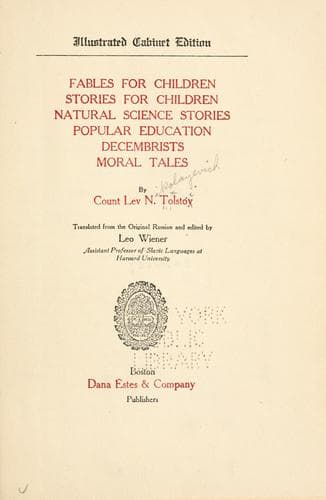
Fables for Children, Stories for Children, Natural Science Stories, Popular Education, Decembrists, Moral TalesTolstoy, Leo, graf
General
Fables for Children, Stories for Children, Natural Science Stories, Popular Education, Decembrists, Moral Tales
Tolstoy, Leo, graf
Russian literature -- Translations into English
Eliséy got up, slung his wallet over his shoulders, and turned back. He
made a circle around the village so that people might not see him. And
soon he reached home. On his way out he had found it hard: it was hard
keeping up with Efím; but on his way home God made it easy for him, for
he did not know what weariness was. Walking was just play to him, and he
swayed his staff, and made as much as seventy versts a day.
Eliséy came back home. The harvest was all in. The home folk were glad
to see the old man. They asked all about him, why he had left his
companion and why he had not gone to Jerusalem, but had returned home.
Eliséy did not tell them anything.
"God did not grant me that I should," he said. "I spent my money on the
way, and got separated from my companion. And so I did not go. Forgive
me for Christ's sake."
He gave the old woman what money he had left. He asked all about the
home matters: everything was right; everything had been attended to and
nothing missed, and all were living in peace and agreement.
Efím's people heard that very day that Eliséy had come back, and so they
came to inquire about their old man. And Eliséy told them the same
story.
"You see," he said, "the old man started to walk briskly, and three days
before St. Peter's day we lost each other. I wanted to catch up with
him, but it happened that I spent all my money and could not go on, so I
returned home."
The people marvelled how it was that such a clever man had acted so
foolishly as to start and not reach the place and merely spend his
money. They wondered awhile, and forgot about it. Eliséy, too, forgot
about it. He began to work about the house: he got the wood ready for
the winter with his son, threshed the grain with the women, thatched the
sheds, gathered in the bees, and gave ten hives with the young brood to
his neighbour. When he got all the work done, he sent his son out to
earn money, and himself sat down in the winter to plait bast shoes and
hollow out blocks for the hives.
VIII.
All that day that Eliséy passed with the sick people, Efím waited for
his companion. He walked but a short distance and sat down. He waited
and waited, and fell asleep; when he awoke, he sat awhile,--but his
companion did not turn up. He kept a sharp lookout for him, but the sun
was going down behind a tree, and still Eliséy was not there.
"I wonder whether he has not passed by me," he thought. "Maybe somebody
drove him past, and he did not see me while I was asleep. But how could
he help seeing me? In the steppe you can see a long distance off. If I
go back, he may be marching on, and we shall only get farther separated
from each other. I will walk on,--we shall meet at the resting-place for
the night."
Public-domain text, read in full here on John Shaqi.
Reviews
Reviews
No reviews yet
Be the first to share your thoughts on this work.
Elsewhere in the archive
Join the Discussion
Join the discussion
Sign in to leave a comment or review.
Sign InorCreate an account