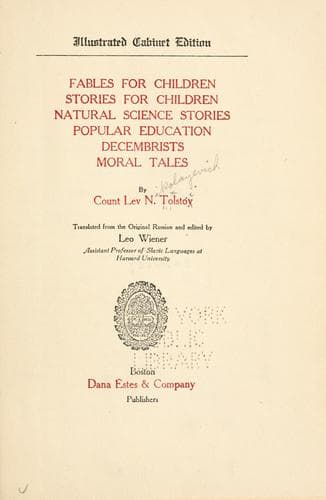
Fables for Children, Stories for Children, Natural Science Stories, Popular Education, Decembrists, Moral TalesTolstoy, Leo, graf
General
Fables for Children, Stories for Children, Natural Science Stories, Popular Education, Decembrists, Moral Tales
Tolstoy, Leo, graf
Russian literature -- Translations into English
"I will buy out the field and the mowing to-morrow, and will buy a
horse, and flour to last until harvest-time, and a cow for the children.
For how would it be to go beyond the sea to seek Christ and lose him
within me? I must get the people started."
And Eliséy fell asleep until morning. He awoke early. He went to the
rich merchant, bought out the rye and gave him money for the mowing. He
bought a scythe,--for that had been sold, too,--and brought it home. He
sent the man out to mow, and himself went to see the peasants: he found
a horse and a cart for sale at the innkeeper's. He bargained with him
for it, and bought it; then he bought a bag of flour, which he put in
the cart, and went out to buy a cow. As he was walking, he came across
two Little-Russian women, and they were talking to one another. Though
they were talking in their dialect, he could make out what they were
saying about him:
"You see, at first they did not recognize him; they thought that he was
just a simple kind of a man. They say, he went in to get a drink, and he
has just stopped there. What a lot of things he has bought them! I
myself saw him buy a horse and cart to-day of the innkeeper. Evidently
there are such people in the world. I must go and take a look at him."
When Eliséy heard that, he understood that they were praising him, and
so he did not go to buy the cow. He returned to the innkeeper and gave
him the money for the horse. He hitched it up and drove with the flour
to the house. When he drove up to the gate, he stopped and climbed down
from the cart. When the people of the house saw the horse, they were
surprised. They thought that he had bought the horse for them, but did
not dare say so. The master came out to open the gates.
"Grandfather, where did you get that horse?"
"I bought it," he said. "I got it cheap. Mow some grass and put it in
the cart, so that the horse may have some for the night. And take off
the bag!"
The master unhitched the horse, carried the bag to the granary, mowed a
lot of grass, and put it into the cart. They lay down to sleep. Eliséy
slept in the street, and thither he had carried his wallet in the
evening. All the people fell asleep. Eliséy got up, tied his wallet, put
on his shoes and his caftan, and started down the road to catch up with
Efím.
VII.
Eliséy had walked about five versts, when day began to break. He sat
down under a tree, untied his wallet, and began to count his money. He
found that he had seventeen roubles twenty kopeks left.
"Well," he thought, "with this sum I cannot travel beyond the sea, but
if I beg in Christ's name, I shall only increase my sin. Friend Efím
will reach the place by himself, and will put up a candle for me. But I
shall evidently never fulfil my vow. The master is merciful, and he will
forgive me."
Public-domain text, read in full here on John Shaqi.
Reviews
Reviews
No reviews yet
Be the first to share your thoughts on this work.
Elsewhere in the archive
Join the Discussion
Join the discussion
Sign in to leave a comment or review.
Sign InorCreate an account