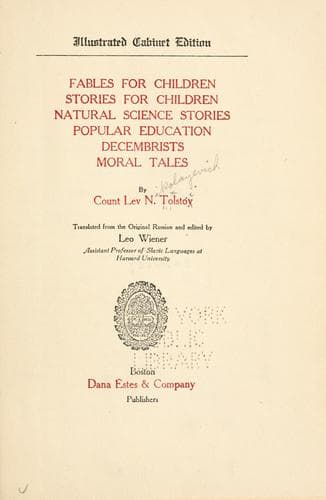
Fables for Children, Stories for Children, Natural Science Stories, Popular Education, Decembrists, Moral TalesTolstoy, Leo, graf
General
Fables for Children, Stories for Children, Natural Science Stories, Popular Education, Decembrists, Moral Tales
Tolstoy, Leo, graf
Russian literature -- Translations into English
And no sooner had Athanasius thought so than he saw the angel who used
to bless him standing in the road and looking threateningly at him. And
Athanasius was frightened and only said:
"For what, O Lord?"
And the angel opened his lips, and said:
"Go hence! You are not worthy of living with your brother. One leap of
your brother is worth all the deeds which you have done with your gold."
And Athanasius began to speak of how many poor people and pilgrims he
had fed, and how many orphans he had housed. And the angel said:
"The devil who placed the gold there has also taught you these words."
Then only did his conscience trouble him, and he saw that he had done
his deeds not for God, and he wept and began to repent.
The angel stepped out of the road and opened the path on which his
brother, John, was already standing and waiting for him. After that
Athanasius no longer submitted to the temptation of the devil who had
scattered the gold, and he understood that not with gold, but only with
words can we serve God and men.
And the brothers began to live as before.
ILYÁS
In the Government of Ufá there lived a Bashkir, Ilyás. His father had
left him no wealth. His father had died a year after he had got his son
married. At that time Ilyás had seven mares, two cows, and a score of
sheep; but Ilyás was a good master and began to increase his
possessions; he worked with his wife from morning until night, got up
earlier than anybody, and went to bed later, and grew richer from year
to year. Thus Ilyás passed thirty-five years at work, and came to have a
vast fortune.
Ilyás finally had two hundred head of horses, 150 head of cattle, and
twelve hundred sheep. Men herded Ilyás's herds and flocks, and women
milked the mares and cows, and made kumys, butter, and cheese. Ilyás had
plenty of everything, and in the district everybody envied him his life.
People said:
"Ilyás is a lucky fellow. He has plenty of everything,--he does not need
to die."
Good people made Ilyás's friendship and became his friends. And guests
came to him from a distance. He received them all, and fed them, and
gave them to drink. No matter who came, he received kumys, and tea, and
sherbet, and mutton. If guests came to see him, a sheep or two were
killed, and if many guests arrived, he had them kill a mare.
Ilyás had two sons and a daughter. He had got all of them married. When
Ilyás had been poor, his sons had worked with him and had herded the
horses and the cattle and the sheep; but when they grew rich, the sons
became spoiled, and one of them even began to drink. One of them, the
eldest, was killed in a fight, and the other, the younger, had a proud
wife, and did not obey his father, and his father had to give him a
separate maintenance.
Public-domain text, read in full here on John Shaqi.
Reviews
Reviews
No reviews yet
Be the first to share your thoughts on this work.
Elsewhere in the archive
Join the Discussion
Join the discussion
Sign in to leave a comment or review.
Sign InorCreate an account