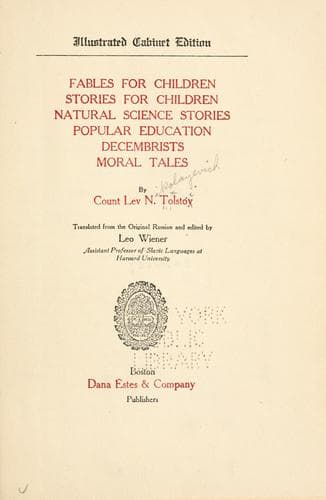
Fables for Children, Stories for Children, Natural Science Stories, Popular Education, Decembrists, Moral TalesTolstoy, Leo, graf
General
Fables for Children, Stories for Children, Natural Science Stories, Popular Education, Decembrists, Moral Tales
Tolstoy, Leo, graf
Russian literature -- Translations into English
Ilyás gave him a house and cattle, and his own wealth was diminished.
Soon after a plague fell on Ilyás's sheep, and many of them died. Then
there was a famine year, the hay crop was a failure, and in the winter
many head of cattle died. Then the Kirgizes drove off the best herd of
horses. And thus Ilyás's estate grew less, and he fell lower and lower,
and his strength began to wane.
When he was seventy years old, he began to sell off his furs, rugs,
saddles, and tents, and soon had to sell his last head of cattle, so
that he was left without anything. Before he knew it, all was gone, and
in his old age he had to go with his wife to live among strangers. All
that Ilyás had left of his fortune was what garments he had on his body,
a fur coat, a cap, and his morocco slippers and shoes, and his wife,
Sham-shemagi, who was now an old woman. The son to whom he had given the
property had left for a distant country, and his daughter had died. And
so there was nobody to help the old people.
Their neighbour, Muhamedshah, took pity on them. Muhamedshah was neither
rich nor poor, and he lived an even life, and was a good man. He
remembered Ilyás's hospitality, and so pitied him, and said to Ilyás:
"Come to live with me, Ilyás, and bring your wife with you! In the
summer work according to your strength in my truck-garden, and in the
winter feed the cattle, and let Sham-shemagi milk the mares and make
kumys. I will feed and clothe you and will let you have whatever you may
need."
Ilyás thanked his neighbour, and went to live with his wife as
Muhamedshah's labourers. At first it was hard for them, but soon they
got used to the work, and the old people worked according to their
strength.
It was profitable for the master to keep these people, for they had been
masters themselves and knew all the order and were not lazy, but worked
according to their strength; but it pained Muhamedshah to see the
well-to-do people brought down so low.
One day distant guests, match-makers, happened to call on Muhamedshah;
and the mulla, too, came. Muhamedshah ordered his men to catch a sheep
and kill it. Ilyás flayed the sheep and cooked it and sent it in to the
guests. They ate the mutton, drank tea, and then started to drink kumys.
The guests and the master were sitting on down cushions on the rugs,
drinking kumys out of bowls, and talking; but Ilyás got through with his
work and walked past the door. When Muhamedshah saw him, he said to a
guest:
"Did you see the old man who just went past the door?"
"I did," said the guest; "but what is there remarkable about him?"
"What is remarkable is that he used to be our richest man. Ilyás is his
name; maybe you have heard of him?"
"Of course I have," said the guest. "I have never seen him, but his fame
has gone far abroad."
"Now he has nothing left, and he lives with me as a labourer, and his
wife is with him,--she milks the cows."
The guest was surprised. He clicked with his tongue, shook his head, and
said:
Public-domain text, read in full here on John Shaqi.
Reviews
Reviews
No reviews yet
Be the first to share your thoughts on this work.
Elsewhere in the archive
Join the Discussion
Join the discussion
Sign in to leave a comment or review.
Sign InorCreate an account