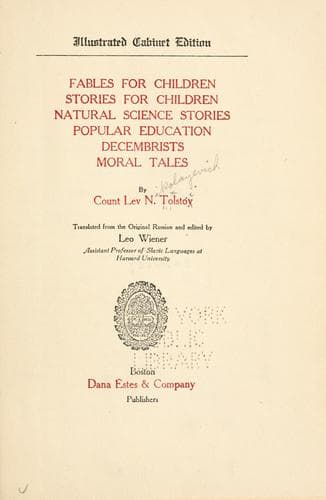
Fables for Children, Stories for Children, Natural Science Stories, Popular Education, Decembrists, Moral TalesTolstoy, Leo, graf
General
Fables for Children, Stories for Children, Natural Science Stories, Popular Education, Decembrists, Moral Tales
Tolstoy, Leo, graf
Russian literature -- Translations into English
And King Tarás fell on new plans. He began to build himself a new
palace: he commanded the people to haul lumber and stone, and to come to
work, and offered high prices for everything. King Tarás thought that as
before the people would rush to work for him. But, behold, all the
lumber and stone was being hauled to the merchant, and only the
labourers were rushing to the king.
King Tarás offered higher prices, but the merchant went higher still.
King Tarás had much money, but the merchant had more still, and the
merchant could offer better pay than the king. The royal palace came to
a standstill,--it could not be built.
King Tarás wanted to get a garden laid out. When the fall came, King
Tarás proclaimed that he wanted people to come and set out trees for
him; but nobody came, as they were all digging a pond for the merchant.
Winter came. King Tarás wanted to buy sable furs for a new coat, and he
sent out men to buy them. The messenger came back, and said that there
were no sables,--that all the furs were in the merchant's possession, as
he had offered a higher price, and that he had made himself a sable rug.
King Tarás wanted to have some stallions. He sent messengers to buy them
for him; but they came back, and said that the merchant had all the good
stallions, and they were hauling water and filling up the pond.
All the business of the king came to a stop. Men would not do anything
for him, but worked only for the merchant; all he received was the
merchant's money, for taxes.
And the king collected such a mass of money that he did not know what to
do with it, and his life grew bad. The king stopped planning things, and
only thought of how he might pass his life peacefully, but he could not
do so. He was oppressed in everything. His cooks, and his coachmen, and
his servants began to leave him for the merchant. And he began to suffer
for lack of food. He would send the women to market to buy provisions,
but there was nothing there, for the merchant bought up everything, and
all he received was money for taxes.
King Tarás grew angry and sent the merchant abroad; but the merchant
settled at the border and continued to do his work: as before, people
dragged for the merchant's money all the things from the king to him.
The king was in a bad plight: he did not eat for days at a time, and the
rumour was spread that the merchant was boasting that he was going to
buy the king himself with his money. King Tarás lost his courage, and
did not know what to do.
Semén the Warrior came to him, and said:
"Support me, for the King of India has vanquished me."
But Tarás himself was pinched.
"I have not eaten myself for two days," he said.
XI.
The old devil had done up the two brothers, and now went to Iván. The
old devil took the shape of a general, and he came to Iván and tried to
persuade him to provide himself with an army.
Public-domain text, read in full here on John Shaqi.
Reviews
Reviews
No reviews yet
Be the first to share your thoughts on this work.
Elsewhere in the archive
Join the Discussion
Join the discussion
Sign in to leave a comment or review.
Sign InorCreate an account