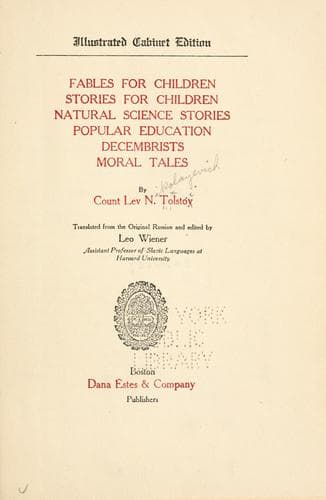
Fables for Children, Stories for Children, Natural Science Stories, Popular Education, Decembrists, Moral TalesTolstoy, Leo, graf
General
Fables for Children, Stories for Children, Natural Science Stories, Popular Education, Decembrists, Moral Tales
Tolstoy, Leo, graf
Russian literature -- Translations into English
Ermák took with him fifty men and went out to clear the road for the
Bukhara merchants. He came to the Irtýsh River, but did not find the
Bukharans. He remained there over night. It was a dark night, and it
rained. The Cossacks had just lain down to sleep, when suddenly the
Tartars rushed out and threw themselves on the sleepy men and began to
strike them down. Ermák jumped up and began to fight. He was wounded in
the hand. He ran toward the river. The Tartars after him. He threw
himself into the river. That was the last time he was seen. His body was
not recovered, and no one found out how he died.
The following year came the Tsar's army, and the Tartars were pacified.
NATURAL SCIENCE STORIES
1869-1872
NATURAL SCIENCE STORIES
STORIES FROM PHYSICS
THE MAGNET
I.
In olden days there was a shepherd whose name was Magnes. Magnes lost a
sheep. He went to the mountains to find it. He came to a place where
there were barren rocks. He walked over these rocks, and felt that his
boots were sticking to them. He touched them with his hand, but they
were dry and did not stick to his hand. He started to walk again, and
again his boots stuck to the rocks. He sat down, took off one of his
boots, took it into his hand, and touched the rocks with it.
Whenever he touched them with his skin, or with the sole of his boot,
they did not stick; but when he touched them with the nails, they did
stick.
Magnes had a cane with an iron point.
He touched a rock with the wood; it did not stick; he touched it with
the iron end, and it stuck so that he could not pull it off.
Magnes looked at the stone, and he saw that it looked like iron, and he
took pieces of that stone home with him. Since then that rock has been
known, and has been called Magnet.
II.
Magnet is found in the earth with iron ore. Where there is magnet in the
ore, the iron is of the best quality. The magnet resembles iron.
If you put a piece of iron on a magnet, the iron itself begins to
attract other iron. And if you put a steel needle on a magnet, and hold
it thus for awhile, the needle will become a magnet, and will attract
iron. If two magnets are brought together at their ends, one side will
turn away from the other, while the other sides will be attracted.
If a magnetic rod is broken in two, each half will attract at one end,
and will turn away at the other end. Cut it again, and the same will
happen; cut it again, as often as you please, and still the same will
happen: equal ends will turn away from each other, while opposite ends
will be attracted, as though the magnet were pushing away at one end,
and pulling in at the other. No matter how you may break it, it will be
as though there were a bump at one end, and a saucer at the other.
Whichever way you put them together,--a bump and a saucer will meet, but
a bump and a bump, or a saucer and a saucer will not.
III.
Public-domain text, read in full here on John Shaqi.
Reviews
Reviews
No reviews yet
Be the first to share your thoughts on this work.
Elsewhere in the archive
Join the Discussion
Join the discussion
Sign in to leave a comment or review.
Sign InorCreate an account