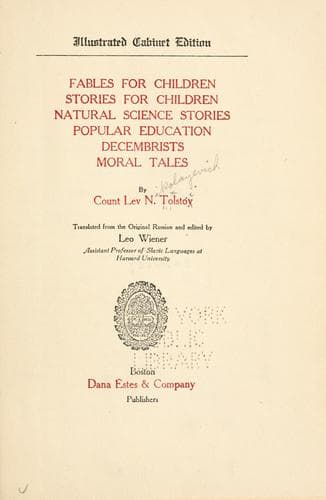
Fables for Children, Stories for Children, Natural Science Stories, Popular Education, Decembrists, Moral TalesTolstoy, Leo, graf
General
Fables for Children, Stories for Children, Natural Science Stories, Popular Education, Decembrists, Moral Tales
Tolstoy, Leo, graf
Russian literature -- Translations into English
If you magnetize a needle (holding it for awhile over a magnet), and
attach it in the middle to a pivot in such a way that it can move freely
around, and let it loose, it will turn with one end toward midday
(south), and with the other toward midnight (north).
When the magnet was not known, people did not sail far out to sea. When
they went out far into the sea, so that land was not to be seen, they
could tell only by the stars and the sun where they had to sail. But
when it was dark, and the sun or stars could not be seen, they did not
know which way to sail. And a ship was borne by the winds and carried on
rocks and wrecked.
So long as the magnet was not known, they did not sail far from the
shore; but when the magnet was discovered, they made a magnetic needle
on a pivot, so that it should move around freely. By this needle they
could tell in which direction to sail. With the magnetic needle they
began to sail farther away from the shores, and since then they have
discovered many new seas.
On ships there is always a magnetic needle (compass), and there is a
measuring-rope with knots at the stern of a ship. This rope is fixed in
such a way that when it unrolls, they can tell how far the ship has
travelled. And thus, in sailing in a boat, they always know in what spot
it is, whether far from the shore, and in what direction it is sailing.
MOISTURE
I.
Why does a spider sometimes make a close cobweb, and sit in the very
middle of its nest, and at other times leave its nest and start a new
spider-web?
The spider makes its cobweb according to the weather, both the present
and the future weather. Looking at a spider, you can tell what kind of
weather it is going to be: if it sits tightly in the middle of the
cobweb and does not come out, it means that it is going to rain. If it
leaves the nest and makes new cobwebs, it is going to clear off.
How can the spider know in advance what weather it is going to be?
The spider's senses are so fine that as soon as the moisture begins to
gather in the air,--though we do not yet feel it, and for us the weather
is clear,--for the spider it is already raining.
Just as a naked man will feel the moisture, when a man in his clothes
does not, so it is already raining for a spider, while for us it is only
getting ready to rain.
II.
Why do the doors swell in the winter and close badly, while in the
summer they shrink and close well?
Because in the fall and winter the wood is saturated with water, like a
sponge, and spreads out, while in the summer the water comes out as a
vapour, and the wood shrinks.
Why does soft wood, like aspen, swell more, and oak less?
Because in the hard wood, in the oak, the empty places are smaller, and
the water cannot gather there, while in the soft wood in the aspen,
there are larger empty places, and the water can gather there. In rotten
wood these empty places are still larger, and so rotten wood swells most
and shrinks most.
Public-domain text, read in full here on John Shaqi.
Reviews
Reviews
No reviews yet
Be the first to share your thoughts on this work.
Elsewhere in the archive
Join the Discussion
Join the discussion
Sign in to leave a comment or review.
Sign InorCreate an account