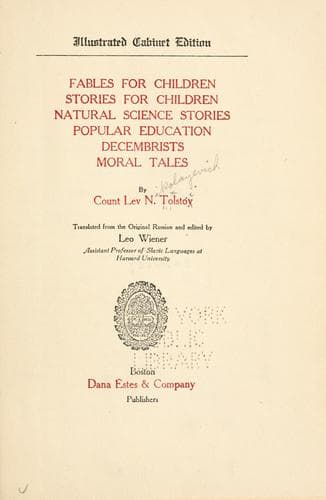
Fables for Children, Stories for Children, Natural Science Stories, Popular Education, Decembrists, Moral TalesTolstoy, Leo, graf
General
Fables for Children, Stories for Children, Natural Science Stories, Popular Education, Decembrists, Moral Tales
Tolstoy, Leo, graf
Russian literature -- Translations into English
If water is saturated with simple salt and heated, and is allowed to
pass away in vapour, the superfluous salt will not settle as powder, but
as little cubes. If the water is saturated both with salt and saltpetre,
the superfluous salt and saltpetre will not mix, but will settle each in
its own way: the saltpetre in columns, and the salt in cubes.
If water is saturated with lime, or with some other salt, and anything
else, each thing will settle in its own way, when the water passes away
in vapour: one in three-edged columns, another in eight-edged columns, a
third in bricks, a fourth in little stars,--each in its own way. These
figures are different in each solid thing. At times these forms are as
large as a hand,--such stones are found in the ground. At times these
forms are so small that they cannot be made out with the naked eye; but
in each thing there is its own form.
If, when the water is saturated with saltpetre, and little figures are
forming in it, a corner be broken off one of these little figures with a
needle, new pieces of saltpetre will come up and will fix the broken end
as it ought to be,--into a six-edged column. The same will happen to
salt and to any other thing. All the tiny particles turn around and
attach themselves with the right side to each other.
When ice freezes, the same takes place.
A snowflake flies, and no figure is seen in it; but the moment it
settles on anything dark and cold, on cloth, on fur,--you can make out
its figure; you will see a little star, or a six-cornered little board.
On the windows the steam does not freeze in any form whatever, but
always as a star.
What is ice? It is cold, solid water. When liquid water becomes solid,
it forms itself into figures and the heat leaves it. The same takes
place with saltpetre: when it changes from a liquid into solid figures,
the heat leaves it. The same is true of salt, of melted cast-iron, when
it changes from a liquid into a solid. Whenever a thing changes from a
liquid into a solid, heat leaves it, and it forms figures. And when it
changes from a solid to a liquid it takes up heat, and the cold leaves
it, and its figures are dissolved.
Bring in melted iron and let it cool off; bring in hot dough and let it
cool off; bring in slacked lime and let it cool off,--and it will be
warm. Bring in ice and let it melt,--and it will grow cold. Bring in
saltpetre, salt, or any other thing that dissolves in the water, and
melt it in the water, and it will grow cold. In order to freeze
ice-cream, they put salt in the water.
INJURIOUS AIR
In the village of Nikólskoe, the people went on a holiday to mass. In
the manor yard were left the cow-tender, the elder, and the groom. The
cow-tender went to the well for water. The well was in the yard itself.
She pulled out the bucket, but could not hold it. The bucket pulled away
from her, struck the side of the well, and tore the rope. The cow-tender
returned to the hut and said to the elder:
Public-domain text, read in full here on John Shaqi.
Reviews
Reviews
No reviews yet
Be the first to share your thoughts on this work.
Elsewhere in the archive
Join the Discussion
Join the discussion
Sign in to leave a comment or review.
Sign InorCreate an account