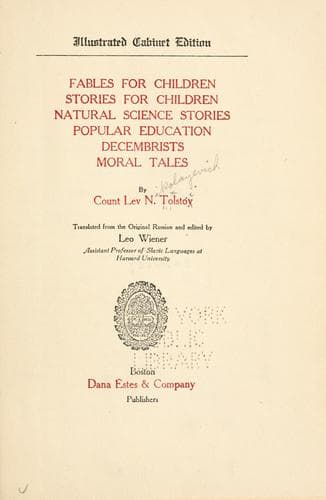
Fables for Children, Stories for Children, Natural Science Stories, Popular Education, Decembrists, Moral TalesTolstoy, Leo, graf
General
Fables for Children, Stories for Children, Natural Science Stories, Popular Education, Decembrists, Moral Tales
Tolstoy, Leo, graf
Russian literature -- Translations into English
Beehives are made out of the softest and rottenest wood; the very best
are made from rotten willow wood. Why? Because the air passes through
the rotten wood, and in such a hive the bees feel better.
Why do boards warp?
Because they dry unevenly. If you place a damp board with one side
toward the stove, the water will leave it, and the board will contract
on that side and will pull the other side along; but the damp side
cannot contract, because it is full of water, and so the whole board
will be bent.
To keep the floors from warping, the dry boards are cut into small
pieces, and these pieces are boiled in water. When all the water is
boiled out of them, they are glued together, and then they never warp
(parquetry).
THE DIFFERENT CONNECTION OF PARTICLES
Why are cart bolsters cut and wheel naves turned not from oak, but from
birch? Bolsters and naves have to be strong, and oak is not more
expensive than birch.
Because oak splits lengthwise, and birch does not split, but ravels out.
Because, though oak is more firmly connected than birch, it is connected
in such a way that it splits lengthwise, while birch does not.
Why are wheels and runners bent from oak and elm, and not from birch and
linden?
Because, when oak and elm are steamed in a bath, they bend and do not
break, while birch and linden ravel in every direction.
This is again for the same reason, that is, that the particles of the
wood in the oak and in the birch are differently connected.
CRYSTALS
If you pour salt into water and stir it, the salt will begin to melt and
will entirely disappear; but if you pour more and still more salt into
it, the salt will in the end not dissolve, and no matter how much you
may stir after that, the salt will remain as a white powder. The water
is saturated with the salt and cannot receive any more. But heat the
water and it will receive more; and the salt which did not dissolve in
the cold water, will melt in hot water. But pour in more salt, even the
hot water will not receive it. And if you heat the water still more, the
water will pass away in steam, and more of the salt will be left.
Thus, for everything which dissolves in the water there is a measure
after which the water will not dissolve any more. Of anything, more will
be dissolved in hot than in cold water, and in each case, when it is
saturated, it will not receive any more. The thing will be left, but the
water will go away in steam.
If the water is saturated with saltpetre powder, and then more saltpetre
is added, and all is heated and is allowed to cool off without being
stirred, the superfluous saltpetre will not settle as a powder at the
bottom of the water, but will all gather in little six-edged columns,
and will settle at the bottom and at the sides, one column near another.
If the water is saturated with saltpetre powder and is put in a warm
place, the water will go away in vapours, and the superfluous saltpetre
will again gather in six-edged columns.
Public-domain text, read in full here on John Shaqi.
Reviews
Reviews
No reviews yet
Be the first to share your thoughts on this work.
Elsewhere in the archive
Join the Discussion
Join the discussion
Sign in to leave a comment or review.
Sign InorCreate an account