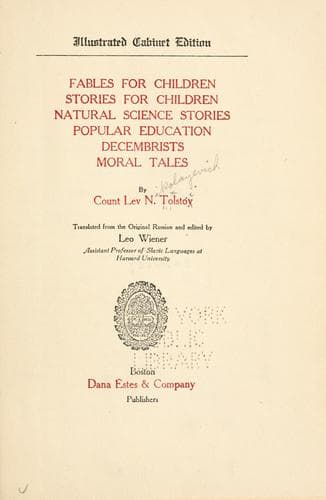
Fables for Children, Stories for Children, Natural Science Stories, Popular Education, Decembrists, Moral TalesTolstoy, Leo, graf
General
Fables for Children, Stories for Children, Natural Science Stories, Popular Education, Decembrists, Moral Tales
Tolstoy, Leo, graf
Russian literature -- Translations into English
When hounds follow an animal's trail, they never run on the track
itself, but to one side, about twenty paces from it. When an
inexperienced hunter wants to show the dog the scent, and sticks its
nose on the track, it will always jump to one side. The track itself
smells so strong to the dog that it cannot make out on the track whether
the animal has run ahead or backward. It runs to one side, and then only
discovers in what direction the scent grows stronger, and so follows the
animal. The dog does precisely what we do when somebody speaks very loud
in our ears; we step a distance away, and only then do we make out what
is being said. Or, if anything we are looking at is too close, we step
back and only then make it out.
Dogs recognize each other and make signs to each other by means of their
scent.
The scent is more delicate still in insects. A bee flies directly to the
flower that it wants to reach; a worm crawls to its leaf; a bedbug, a
flea, a mosquito scents a man a hundred thousand of its steps away.
If the particles which separate from a substance and enter our noses are
small, how small must be those particles that reach the organ of smell
of the insects!
TOUCH AND SIGHT
Twist the forefinger over the middle finger and touch a small ball with
them, so that it may roll between the two fingers, and shut your eyes.
You will think that there are two balls. Open your eyes,--and you will
see that it is one ball. The fingers have deceived you, but the eyes
correct you.
Look (best of all sidewise) at a good, clean mirror,--you will think
that it is a window or a door, and that there is something behind it.
Touch it with a finger,--and you will see that it is a mirror. The eyes
have deceived you, but the fingers correct you.
THE SILKWORM
I had some old mulberry-trees in my garden. My grandfather had planted
them. In the fall I was given a dram of silkworm eggs, and was advised
to hatch them and raise silkworms. These eggs are dark gray and so small
that in that dram I counted 5,835 of them. They are smaller than the
tiniest pin-head. They are quite dead; only when you crush them do they
crack.
The eggs had been lying around on my table, and I had almost forgotten
about them.
One day, in the spring, I went into the orchard and noticed the buds
swelling on the mulberry-trees, and where the sun beat down, the leaves
were out. I thought of the silkworm eggs, and took them apart at home
and gave them more room. The majority of the eggs were no longer dark
gray, as before, but some were light gray, while others were lighter
still, with a milky shade.
The next morning, I looked at the eggs, and saw that some of the worms
had hatched out, while other eggs were quite swollen. Evidently they
felt in their shells that their food was ripening.
Public-domain text, read in full here on John Shaqi.
Reviews
Reviews
No reviews yet
Be the first to share your thoughts on this work.
Elsewhere in the archive
Join the Discussion
Join the discussion
Sign in to leave a comment or review.
Sign InorCreate an account