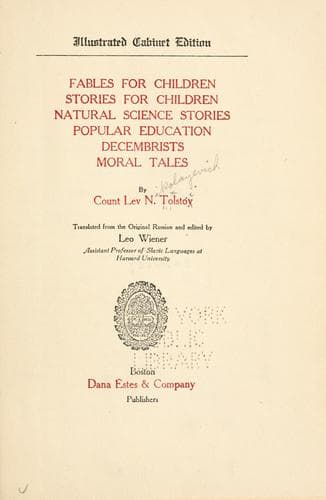
Fables for Children, Stories for Children, Natural Science Stories, Popular Education, Decembrists, Moral TalesTolstoy, Leo, graf
General
Fables for Children, Stories for Children, Natural Science Stories, Popular Education, Decembrists, Moral Tales
Tolstoy, Leo, graf
Russian literature -- Translations into English
The worms were black and shaggy, and so small that it was hard to see
them. I looked at them through a magnifying-glass, and saw that in the
eggs they lay curled up in rings, and when they came out they
straightened themselves out. I went to the garden for some mulberry
leaves; I got about three handfuls of leaves, which I put on my table,
and began to fix a place for the worms, as I had been taught to do.
While I was fixing the paper, the worms smelled their food and started
to crawl toward it. I pushed it away, and began to entice the worms to a
leaf, and they made for it, as dogs make for a piece of meat, crawling
after the leaf over the cloth of the table and across pencils, scissors,
and papers. Then I cut off a piece of paper, stuck holes through it with
a penknife, placed the leaf on top of it, and with the leaf put it down
on the worms. The worms crawled through the holes, climbed on the leaf,
and started to eat.
When the other worms hatched out, I again put a piece of paper with a
leaf on them, and all crawled through the holes and began to eat. The
worms gathered on each leaf and nibbled at it from its edges. Then, when
they had eaten everything, they crawled on the paper and looked for more
food. Then I put on them new sheets of perforated paper with mulberry
leaves upon them, and they crawled over to the new food.
They were lying on my shelf, and when there was no leaf, they climbed
about the shelf, and came to its very edge, but they never fell down,
though they are blind. The moment a worm comes to an edge, it lets out a
web from its mouth before descending, and then it attaches itself to it
and lets itself down; it hangs awhile in the air, and watches, and if it
wants to get down farther, it does so, and if not, it pulls itself up by
its web.
For days at a time the worms did nothing but eat. I had to give them
more and more leaves. When a new leaf was brought, and they transferred
themselves to it, they made a noise as though a rain were falling on
leaves,--that was when they began to eat the new leaf.
Thus the older worms lived for five days. They had grown very large and
began to eat ten times as much as ever. On the fifth day, I knew, they
would fall asleep, and waited for that to happen. Toward evening, on the
fifth day, one of the older worms stuck to the paper and stopped eating
and stirring.
The whole next day I watched it for a long time. I knew that worms
moulted several times, because they grew up and found it close in their
old hide, and so put on a new one.
My friend and I watched it by turns. In the evening my friend called
out:
"It has begun to undress itself,--come!"
Public-domain text, read in full here on John Shaqi.
Reviews
Reviews
No reviews yet
Be the first to share your thoughts on this work.
Elsewhere in the archive
Join the Discussion
Join the discussion
Sign in to leave a comment or review.
Sign InorCreate an account