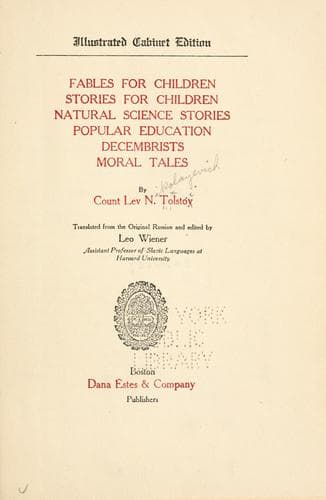
Fables for Children, Stories for Children, Natural Science Stories, Popular Education, Decembrists, Moral TalesTolstoy, Leo, graf
General
Fables for Children, Stories for Children, Natural Science Stories, Popular Education, Decembrists, Moral Tales
Tolstoy, Leo, graf
Russian literature -- Translations into English
I knew that from these larvæ with their white, waxen bodies would come
butterflies; but as I looked at them, I could not believe it. None the
less I went to look at them on the twentieth day, to see what had become
of them.
On the twentieth day, I knew, there was to be a change. Nothing was to
be seen, and I was beginning to think that something was wrong, when
suddenly I noticed that the end of one of the cocoons grew dark and
moist. I thought that it had probably spoiled, and wanted to throw it
away. But then I thought that perhaps it began that way, and so I
watched to see what would happen. And, indeed, something began to move
at the wet end. For a long time I could not make out what it was. Later
there appeared something like a head with whiskers. The whiskers moved.
Then I noticed a leg sticking out through the hole, then another, and
the legs scrambled to get out of the cocoon. It came out more and more,
and I saw a wet butterfly. When all six legs scrambled out, the back
jumped out, too, and the butterfly crawled out and stopped. When it
dried it was white; it straightened its wings, flew away, circled
around, and alighted on the window.
Two days later the butterfly on the window-sill laid eggs in a row, and
stuck them fast. The eggs were yellow. Twenty-five butterflies laid
eggs. I collected five thousand eggs. The following year I raised more
worms, and had more silk spun.
STORIES FROM BOTANY
THE APPLE-TREE
I set out two hundred young apple-trees, and for three years I dug
around them in the spring and the fall, and in winter wrapped them with
straw against the hares. On the fourth year, when the snow melted, I
went to take a look at my apple-trees. They had grown stouter during the
winter: the bark was glossy and filled with sap; all the branches were
sound, and at all the tips and axils there were pea-shaped flower-buds.
Here and there the buds were bursting, and the purple edges of the
flower-leaves could be seen. I knew that all the buds would be blossoms
and fruit, and I was delighted as I looked at the apple-trees. But when
I took off the wrapping from the first tree, I saw that down at the
ground the bark was nibbled away, like a white ring, to the very wood.
The mice had done that. I unwrapped a second tree, and the same had
happened there. Of the two hundred trees not one was unharmed. I smeared
pitch and wax on the nibbled spots; but when the trees were all in
bloom, the blossoms at once fell off; there came out small leaves, and
they, too, dropped off. The bark became wrinkled and black. Out of the
two hundred apple-trees only nine were left. On these nine trees the
bark had not been gnawed through all around, but strips of bark were
left on the white ring. On the strips, where the bark held together,
there grew out knots, and, although the trees suffered, they lived. All
the rest were ruined; below the rings there came out shoots, but they
were all wild.
Public-domain text, read in full here on John Shaqi.
Reviews
Reviews
No reviews yet
Be the first to share your thoughts on this work.
Elsewhere in the archive
Join the Discussion
Join the discussion
Sign in to leave a comment or review.
Sign InorCreate an account