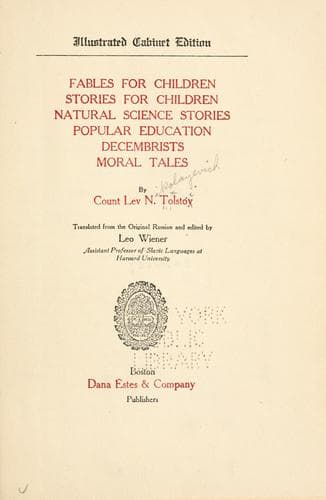
Fables for Children, Stories for Children, Natural Science Stories, Popular Education, Decembrists, Moral TalesTolstoy, Leo, graf
General
Fables for Children, Stories for Children, Natural Science Stories, Popular Education, Decembrists, Moral Tales
Tolstoy, Leo, graf
Russian literature -- Translations into English
I went up to him, and saw that the worm had stuck with its old hide to
the paper, had torn a hole at the mouth, thrust forth its head, and was
writhing and working to get out, but the old shirt held it fast. I
watched it for a long time as it writhed and could not get out, and I
wanted to help it. I barely touched it with my nail, but soon saw that I
had done something foolish. Under my nail there was something liquid,
and the worm died. At first I thought that it was blood, but later I
learned that the worm has a liquid mass under its skin, so that the
shirt may come off easier. With my nail I no doubt disturbed the new
shirt, for, though the worm crawled out, it soon died.
The other worms I did not touch. All of them came out of their shirts in
the same manner; only a few died, and nearly all came out safely, though
they struggled hard for a long time.
After shedding their skins, the worms began to eat more voraciously, and
more leaves were devoured. Four days later they again fell asleep, and
again crawled out of their skins. A still larger quantity of leaves was
now consumed by them, and they were now a quarter of an inch in length.
Six days later they fell asleep once more, and once more came out in new
skins, and now were very large and fat, and we had barely time to get
leaves ready for them.
On the ninth day the oldest worms quit eating entirely and climbed up
the shelves and rods. I gathered them in and gave them fresh leaves, but
they turned their heads away from them, and continued climbing. Then I
remembered that when the worms get ready to roll up into larvæ, they
stop eating and climb upward.
I left them alone, and began to watch what they would do.
The eldest worms climbed to the ceiling, scattered about, crawled in all
directions, and began to draw out single threads in various directions.
I watched one of them. It went into a corner, put forth about six
threads each two inches long, hung down from them, bent over in a
horseshoe, and began to turn its head and let out a silk web which began
to cover it all over. Toward evening it was covered by it as though in a
mist; the worm could scarcely be seen. On the following morning the worm
could no longer be seen; it was all wrapped in silk, and still it spun
out more.
Three days later it finished spinning, and quieted down. Later I learned
how much web it had spun in those three days. If the whole web were to
be unravelled, it would be more than half a mile in length, seldom less.
And if we figure out how many times the worm has to toss its head in
these three days in order to let out all the web, it will appear that in
these three days the worm tosses its head 300,000 times. Consequently,
it makes one turn a second, without stopping. But after the work, when
we took down a few cocoons and broke them open, we found inside the
worms all dried up and white, looking like pieces of wax.
Public-domain text, read in full here on John Shaqi.
Reviews
Reviews
No reviews yet
Be the first to share your thoughts on this work.
Elsewhere in the archive
Join the Discussion
Join the discussion
Sign in to leave a comment or review.
Sign InorCreate an account