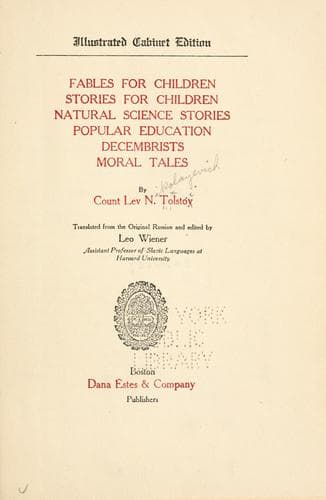
Fables for Children, Stories for Children, Natural Science Stories, Popular Education, Decembrists, Moral TalesTolstoy, Leo, graf
General
Fables for Children, Stories for Children, Natural Science Stories, Popular Education, Decembrists, Moral Tales
Tolstoy, Leo, graf
Russian literature -- Translations into English
Having dressed herself, Natálya Nikoláevna adjusted her collar and
cuffs, which, in spite of the journey, were still clean, combed herself,
and seated herself opposite the table. Her beautiful black eyes gazed
somewhere into the distance: she looked and rested herself. She seemed
to be resting, not from the unpacking alone, nor from the road, nor from
the oppressive years,--she seemed to be resting from her whole life, and
the distance into which she was gazing, and in which she saw living and
beloved faces, was that rest which she was wishing for. Whether it was
an act of love, which she had done for her husband, or the love which
she had experienced for her children when they were young, or whether it
was a heavy loss, or a peculiarity of her character,--everyone who
looked at that woman could not help seeing that nothing could be
expected from her, that she had long ago given all of herself to life,
and that nothing was left of her. All that there was left was something
worthy of respect, something beautiful and sad, as a reminiscence, as
the moonlight. She could not be imagined otherwise than surrounded by
all the comforts of life. It was impossible for her ever to be hungry,
or to eat eagerly, or to have on soiled clothes, or to stumble, or to
forget to clear her nose. It was a physical impossibility. Why it was
so, I do not know, but every motion of hers was dignity, grace,
gentleness toward all those who could enjoy her sight.
"Sie pflegen und weben
Himmlische Rosen ins irdische Leben."
She knew those verses and loved them, but was not guided by them. All
her nature was an expression of that thought; all her life was this one
unconscious weaving of invisible roses in the lives of those with whom
she came in contact. She had followed her husband to Siberia only
because she loved him; she had not thought what she could do for him,
and instinctively had done everything. She had made his bed, had put
away his things, had prepared his dinner and his tea, and, above all,
had always been where he was, and no woman could have given more
happiness to her husband.
In the drawing-room the samovár was boiling on the round table. Natálya
Nikoláevna sat near it. Sónya wrinkled her face and smiled under her
mother's hand, which was tickling her, when father and son, with
wrinkled finger-tips and glossy cheeks and foreheads (the father's bald
spot was particularly glistening), with fluffy white and black hair, and
with beaming countenances, entered the room.
"It has grown brighter since you have come in," said Natálya Nikoláevna.
"O Lord, how white you are!"
Public-domain text, read in full here on John Shaqi.
Reviews
Reviews
No reviews yet
Be the first to share your thoughts on this work.
Elsewhere in the archive
Join the Discussion
Join the discussion
Sign in to leave a comment or review.
Sign InorCreate an account