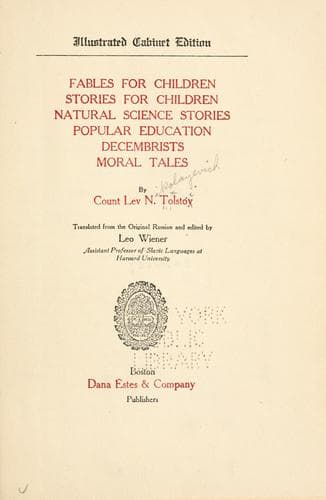
Fables for Children, Stories for Children, Natural Science Stories, Popular Education, Decembrists, Moral TalesTolstoy, Leo, graf
General
Fables for Children, Stories for Children, Natural Science Stories, Popular Education, Decembrists, Moral Tales
Tolstoy, Leo, graf
Russian literature -- Translations into English
She had been saying that each Saturday, for several decades, and each
Saturday Pierre experienced bashfulness and delight, whenever he heard
that. They seated themselves at the table; there was an odour of tea and
of the pipe, and there were heard the voices of the parents, the
children, and the servants, who received their cups in the same room.
They recalled everything funny that had happened on the road, admired
Sónya's hair-dressing, and laughed. Geographically they were all
transferred a distance of five thousand versts, into an entirely
different, strange milieu, but morally they were that evening still at
home, just such as the peculiar, long, solitary family life had made
them to be. It will not be so to-morrow. Peter Ivánovich seated himself
near the samovár, and lighted his pipe. He was not in a cheerful mood.
"So here we are," he said, "and I am glad that we shall not see any one
to-night; this is the last evening we shall pass with the family," and
he washed these words down with a large mouthful of tea.
"Why the last, Pierre?"
"Why? Because the eaglets have learned to fly, and they have to make
their own nests, and from here they will fly each in a different
direction--"
"What nonsense!" said Sónya, taking his glass from him, and smiling at
him, as she smiled at everything. "The old nest is good enough!"
"The old nest is a sad nest; the old man did not know how to make
it,--he was caught in a cage, and in the cage he reared his young ones,
and was let out only when his wings no longer would hold him up. No, the
eaglets must make their nests higher up, more auspiciously, nearer to
the sun; that is what they are his children for, that his example might
serve them; but the old one will look on, so long as he is not blind,
and will listen, when he becomes blind-- Pour in some rum, more,
more--enough!"
"We shall see who is going to leave," replied Sónya, casting a cursory
glance at her mother, as though she felt uneasy speaking in her
presence. "We shall see who is going to leave," she continued. "I am not
afraid for myself, neither am I for Serézha." (Serézha was walking up
and down in the room, thinking of how clothes would be ordered for him
to-morrow, and wondering whether he had better go to the tailor, or send
for him; he was not interested in Sónya's conversation with his father.)
Sónya began to laugh.
"What is the matter? What?" asked her father.
"You are younger than we, papa. Much younger, indeed," she said, again
bursting out into a laugh.
"Indeed!" said the old man, and his austere wrinkles formed themselves
into a gentle, and yet contemptuous, smile.
Natálya Nikoláevna bent away from the samovár which prevented her seeing
her husband.
"Sónya is right. You are still sixteen years old, Pierre. Serézha is
younger in feelings, but you are younger in soul. I can foresee what he
will do, but you will astound me yet."
Public-domain text, read in full here on John Shaqi.
Reviews
Reviews
No reviews yet
Be the first to share your thoughts on this work.
Elsewhere in the archive
Join the Discussion
Join the discussion
Sign in to leave a comment or review.
Sign InorCreate an account