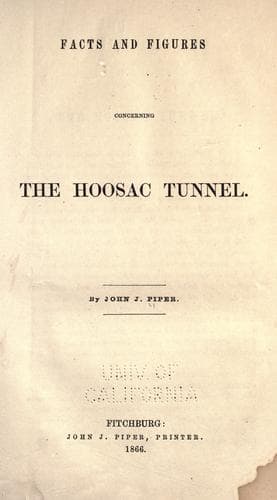
In a review of the history of tunnel legislation, as given in this
pamphlet, passing by the frequent charges of "packed committees,"
"deceived legislatures," and "tricks of legislative legerdemain," we
come to an account of the Act of April, 1862, by which it appears that
the bill passed was not materially different from that prepared by Mr.
Bird, and offered by Mr. Swan. It was _entitled_, "An Act for the More
Speedy Completion of the Hoosac Tunnel," yet the anti-tunnel league
considered its passage "a substantial defeat of the scheme," because
they believed that Governor Andrew "was opposed to the Tunnel," and
would appoint commissioners whose opinions were in harmony with his own.
And the virtuous and honest member of the "Third House," through whose
adroit management, a bill bearing a title so inconsistent with its
purpose, was framed, affects a pious horror of legislative trickery!
Whatever Mr. Bird may have to say upon any of his various topics, he
never forgets to abuse Mr. Brooks; "_Carthago delenda est_" at any rate;
and he returns to the assault at the beginning or end of almost every
chapter, with renewed spitefulness. On page 21 it is represented that
Mr. Laurie, the engineer who had been designated by the governor and
council to make surveys, had a personal interview with Mr. Brooks, and
that the following colloquy took place:--
"I am here, Mr. Brooks, to make the surveys ordered." "What order?
What surveys?" "The surveys ordered by the governor and council."
"I have ordered no surveys and want none. When I need your services
I will send for you. Go about your business."
Even those who have never reckoned Mr. Bird a man of strict veracity
will be surprised to learn that this story is a pure fabrication, that
no such conversation, and no such interview ever took place. The
communications between the two gentlemen were a letter from Mr. Laurie,
who was at Hartford, and a reply by telegraph from Mr. Brooks, who was
in Boston. Mr. Laurie wrote,--"Presuming that you wish me to make these
surveys, I will come to Boston," &c. Mr. Brooks telegraphed,--"The new
survey has not been acted upon by commissioners."
On the same page of the pamphlet it is stated that Mr. Brooks, not being
satisfied with Mr. Laurie's conclusions, "demanded the suppression of
some portions of the report, and the modification of others." "Mr.
Laurie, after making such concessions as he could honestly make,
resolutely refused to yield to Mr. Brooks' imperious demands upon
material points." Now' this representation is just as false as the story
about the colloquy. Mr. Brooks did not make any such demands. An
exposure of both these fabrications is made in a communication to the
Boston Advertiser of March 10th, which contains copies of all the
correspondence on these subjects, between Mr. Brooks and Mr. Laurie.
Public-domain text, read in full here on John Shaqi.
Reviews
Reviews
No reviews yet
Be the first to share your thoughts on this work.
Join the Discussion
Join the discussion
Sign in to leave a comment or review.
Sign InorCreate an account