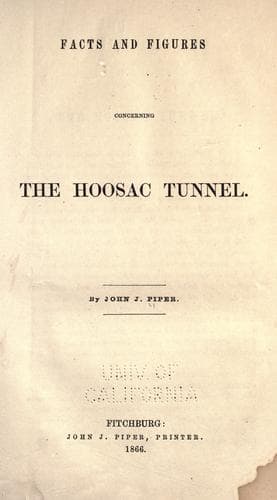
"Twelve years of experience have convinced us that the Western
Railroad is wholly inadequate to the prompt, rapid and cheap
transportation of the commodities so extensively consumed by the
people of the New England States. To illustrate the diversion of
trade from the natural route to Boston via Albany, occasioned by
the incapacity of the Western road to meet the wants of commerce,
we call your attention to the article of flour. We collate our
facts from reports of the Boston Board of Trade and the official
reports of the Western Railroad. In 1865, the Western road,
according to its own report, transported from Albany and Troy to
Boston, one hundred and fifty thousand barrels less than it did in
1847, nearly twenty years ago. During the thirteen years, including
1848 and 1860, the average of its transportation of this article,
per annum, between the Hudson and Boston was 287,698 barrels. For
the same period, there were received in Boston, via other and more
circuitous routes, an average per annum of 670,233 barrels. The
next four years, including 1861 and 1864, the average per annum by
the Western road was 572,637 barrels. Boston received from other
routes an average, per annum for the same period, of 824,937
barrels.
Now, we hold that, by the natural laws of trade, most of this vast
quantity of flour, which reaches Boston in these roundabout ways,
would have left the Hudson river at Albany and Troy, had the
requisite facilities for a cheap and rapid transportation been
afforded. About one-fourth of the average quantity received in
Boston from other routes, for the four years named above, reached
that place via the Grand Trunk Railway and Portland, aggregating
956,945 barrels. Taking Detroit as the starting point, the
distance from there to Boston via Portland, is 228 miles greater
than the route to Boston via Albany. Yet, owing to the inadequate
railroad facilities between Albany and Boston, the consignors of
this flour prefer to send it via Portland, and pay the charges on
228 miles of additional distance. What is true of the article of
flour is equally true of all the staple commodities produced at the
West and consumed by the New England States. Large quantities were
last year turned aside at Rochester and other points in our own
State, to say nothing of points west of Buffalo, and sent to Boston
and contiguous localities via the New York and Erie Railroad.
Boston is even now receiving flour from Albany, Troy and
Schenectady, by way of Rutland, a distance of some fifty miles
further than by the Western road.
Public-domain text, read in full here on John Shaqi.
Reviews
Reviews
No reviews yet
Be the first to share your thoughts on this work.
Join the Discussion
Join the discussion
Sign in to leave a comment or review.
Sign InorCreate an account