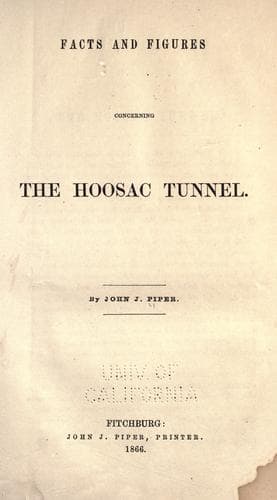
Should our friend of the Salem Gazette, or any of the editors who quote
Mr. F. W. Bird, and write short paragraphs, more flippantly than
intelligently, about the Hoosac Tunnel, chance to be at the freight yard
of the Fitchburg Railroad in Charlestown, on the arrival of a train of
New York Central Railroad cars, laden with flour, grain, or other
products of the West, he would doubtless be as much puzzled to know how
they got there, as he would be, if, standing at the heading of the
tunnel, he should endeavor to reconcile his situation (half a mile from
daylight) with the calculations, statements and predictions of Mr. Bird
and other opponents of the Tunnel enterprise. If our friend were set
down at the freight depot of the Worcester and Nashua Railroad, in
Worcester, he would again be surprised to witness the arrival of
freight-laden cars, bearing the same mark as those he saw at
Charlestown. Upon inquiry of the freight agents he would learn that
freight for Boston and Worcester, is transported from Schenectady, over
the Washington and Saratoga road, and from Troy, over the Troy and
Boston and Western Vermont, to Rutland, Vt., and thence, by the Rutland
and Cheshire roads to Fitchburg, and from there to Boston and Worcester
over other roads. By glancing at a map the intelligent reader will at
once observe what a circuitous and lengthened line of communication
between the New York Central road and the cities of Boston and Worcester
is furnished by the connecting roads above named. The distance from
Schenectady to Boston via Rutland is 247 miles, while it is but 217 by
way of the Western road. The distance from the same point to Worcester
by the Rutland route is 222 miles, and by the Western road only 172. Yet
because the Western road has not capacity to do the business, the
produce dealers of Eastern and Central Massachusetts are compelled to
resort to this roundabout way of transportation as one of their means of
relief. But this is not the only channel, nor the most indirect, which
the irrepressible stream of Western trade with the East has created, as
it approaches its natural outlet, Boston; as the Mississippi, scorning
the narrow embouchure which satisfied its youthful flow, now pours its
resistless torrents, through numerous passes to the Gulf. Besides that
already described, there are three other lines competing with the
Western road in the transportation of Western freight to Boston. These
are the Grand Trunk, the Ogdensburg, and the Providence and Erie. Few
persons know that cotton from St. Louis, for supplying the mills of
Lowell and Lawrence, is unladen in Boston from vessels which received
their cargoes at Portland, but such is the fact, the cotton having been
transported over the Great Western and Grand Trunk roads.
Public-domain text, read in full here on John Shaqi.
Reviews
Reviews
No reviews yet
Be the first to share your thoughts on this work.
Join the Discussion
Join the discussion
Sign in to leave a comment or review.
Sign InorCreate an account