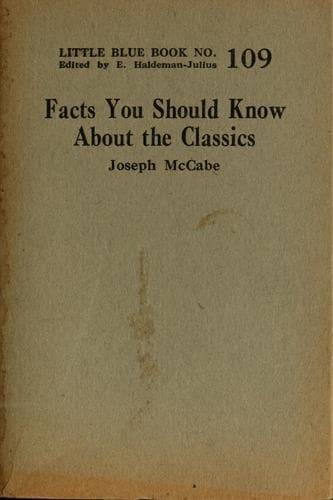
Facts you should know about the classics — John Shaqi
Facts you should know about the classicsMcCabe, Joseph
History
Facts you should know about the classics
McCabe, Joseph
Literature -- History and criticism
The moralist Seneca (4 B. C.-65 A. D.) is famous for the many long
essays or books which he wrote, from the severe Stoic point of view, on
every aspect of virtue and vice. He wrote in the time of Nero, and thus
he reminds us that the corruption of that Emperor and his circle did
not extend to all Rome. A little later was Epictetus, a Greek of the
Roman Empire, whose very austere Stoic sentiments were collected by his
pupils and published as his _Encheiridion_ or _Manual_. Marcus Aurelius
(121-180 A. D.), the most virtuous of the Stoic Emperors, compiled a
little volume of moral _Meditations_, very austere in sentiment, which
is still much read, though it was rather casually written. Another
famous Stoic of the time (died 117 A. D.) was the Greek orator Dion
Chrysostom (“Golden-mouthed”), whose eighty extant orations, mainly
delivered in Rome, are fine literary expressions of the highest ideals
of the time. There was a very considerable output of this severe moral
literature at Rome.
More brilliant from the literary point of view were the satirists
Juvenal (60-140 A. D.), and Martial (40-104). Juvenal’s _Satires_
(five books) are famous in literature, but as pictures of Roman morals
they are not now trusted. He wrote, not only as a poor man flaying the
rich, but he told of the wealthy Romans of the generation before his
own time. Martial has left us fourteen books of _Epigrams_: sprightly
verses, of two or three lines each, hitting off the characters and
manners of his age. He was a wealthy as well as a witty man, and his
mild satires are valuable.
Pliny is the name of two Roman writers who rank as classics. The older
Pliny (23 A. D.-79 A. D.) gives us a summary of the slender scientific
knowledge of the Romans in his _Natural History_. The younger Pliny,
his nephew, was the governor of a province, and his _Letters_ (ten
books) are good literature and valuable documents.
Lucian, of the second century, is rarely read today, but his witty and
pungent _Dialogues_ and his stories and essays put him in the rank of
great writers. Apuleius was another witty story-writer. His _Golden
Ass_ has always been deemed a classic, though modern authorities would
not permit a literal translation of it. The hero imagines himself
turned into an ass by the blunder of a sorcerer and having a series of
most picturesque adventures.
After the middle of the second century Rome was exhausted by war and
literature ceased. There were several writers of some distinction in
the fourth century, but their works are not classics. The great days
of pagan literature were over. The pen passed to the hands of the new
Christian writers.
§3. EARLY CHRISTIAN CLASSICS
Public-domain text, read in full here on John Shaqi.
Reviews
Reviews
No reviews yet
Be the first to share your thoughts on this work.
Join the Discussion
Join the discussion
Sign in to leave a comment or review.
Sign InorCreate an account