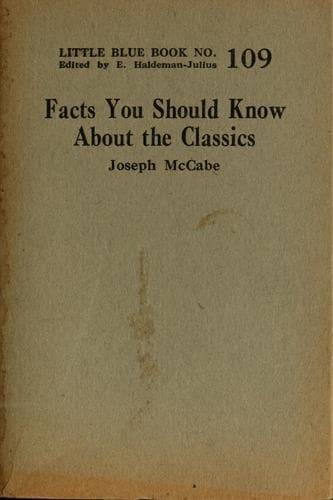
Facts you should know about the classicsMcCabe, Joseph
History
Facts you should know about the classics
McCabe, Joseph
Literature -- History and criticism
The Middle Ages are, roughly, the period from about 500 to 1500,
though we must not take the limits too sharply. Here I propose to make
it cover the writers of the literary Renaissance period, or of the
fifteenth and sixteenth centuries. Europe was so demoralized after
the fall of Rome that art almost perished; and the Greek Empire was
too fossilized to produce great literature. From the second to the
thirteenth century no literary worth of the first, or even second, rank
appeared in Europe. Then art was reborn and the Renaissance in the
broader sense, the re-awakening of Europe, began.
§1. ARAB AND PERSIAN WRITERS
There are, however, two works belonging to that period which will
be known to every reader, at least by name: the _Rubaiyat_ of Omar
Khayyam and the _Arabian Nights_. Omar was a Persian poet-astronomer
of the twelfth century: one of very many gifted poets of the revived
civilization of Persia. The refined Epicurian creed of life in his
well-known poem reminds us that outside of Europe there was a brilliant
and artistic civilization. The _Arabian Nights_ reflects a similarly
brilliant civilization at Cairo and Bagdad and Damascus. This new
Mohammedan, though really very skeptical, culture spread from Persia to
Spain, and had much to do with the re-awakening of Europe.
The _Rubaiyat_, which took the modern world by storm in the nineteenth
century, is a unique case of a translation being superior to the
original. The current version, by the English poet Edward Fitzgerald,
is not, in fact, a translation, but to a very great extent a new poem
based on that of Omar. Sir Richard Burton’s translation (in 16 volumes)
of the _Arabian Nights_ is, on the other hand, so accomplished and
faithful a version of that immortal collection of oriental tales that
it is generally kept behind locked doors in a library. The current
translations are much pruned, and are therefore false. The tales
(by various authors) are generally said to be of the thirteenth and
fourteenth centuries, but Burton held that many are earlier. The well
known stories of Sinbad and Aladdin come from this classic. It is a
rich reflection of Arab-Persian life.
§2. DANTE AND THE MIDDLE AGES
Public-domain text, read in full here on John Shaqi.
Reviews
Reviews
No reviews yet
Be the first to share your thoughts on this work.
Join the Discussion
Join the discussion
Sign in to leave a comment or review.
Sign InorCreate an account