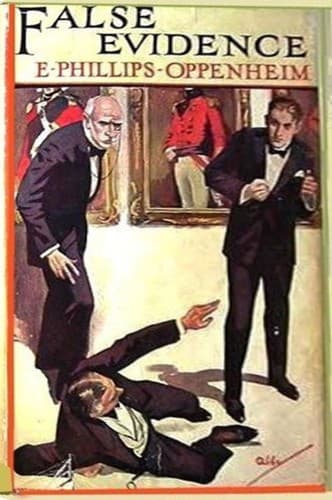
False EvidenceOppenheim, E. Phillips (Edward Phillips)
General
False Evidence
Oppenheim, E. Phillips (Edward Phillips)
Soldiers -- Fiction
It had never troubled me that I had no friends of my own age. Indeed,
I never had need of any, for when I had finished for the day with Mr.
Cox, or on holidays--which came not unfrequently--my father was always
ready to do anything I desired; and what better companion could I have
had? He was a better shot and a far better fencer than I, and, at a
distance, no one would have taken him for more than my elder brother.
He was over six feet in height, and as slim and upright as a dart. His
slight moustaches and hair were, indeed, grey, but they were the only
signs of age, save, perhaps a weary, troubled look which sometimes came
into his face and dwelt there for days. But a good hand-gallop or an
hour or two shooting from a boat round the coombe, used generally to
drive that away; and then his blue eyes would flash as eagerly and his
interest in the sport would be as strong as ever mine was. But, though
we were out in all weathers, sometimes for the whole day together, it
seemed as though neither sun nor wind could do more than very slightly
tan his clear, delicate skin; and his hands, although they were as
tenacious and strong as a bargeman's, remained almost as white and
shapely as a lady's. I used to think him the handsomest man in the
world, and I have certainly never seen a handsomer. To be told that I
was growing like him was to make me supremely happy--and people often
told me so in those days.
No wonder that I grew to love him with more even than an ordinary
filial love. The ties between us were so various, that it would have
been strange had it not been so. To the love of a son for his father,
was added the love which springs from constant companionship whilst
engaged with kindred tastes in following a common object. My mother,
too, claimed a large share of my affection, and so did Marian, my
sister. But neither of them came anywhere near him in my heart.
I was not of a speculative nature, but gradually it had begun to dawn
upon me that we were somehow different from other people--that there
must be some reason for the absolute and unbroken solitude in which we
lived, and the events of the last two days had now made this certain.
"The boy must be told." What was it that I must be told? I had
thought that I should have known this very evening, for just as I was
going to bed my father had called me to him.
"Hugh," he had said kindly, "you were saying something last night about
never having been away from this place. You were quite right. You
must not live here always. There has been a reason, a very grave
reason, for our having lived here so long and in such solitude. You
must be told that reason."
I could see that he was agitated, and a vague yet strong sense of
trouble filled me.
"Do not tell me now, father," I cried; "do not tell me at all if it
distresses you. I will ask no more questions. I will be content to
live on here always as we are doing now."
He shook his head slowly.
Public-domain text, read in full here on John Shaqi.
Reviews
Reviews
No reviews yet
Be the first to share your thoughts on this work.
Join the Discussion
Join the discussion
Sign in to leave a comment or review.
Sign InorCreate an account