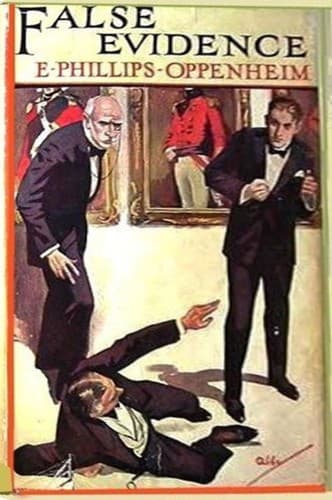
False EvidenceOppenheim, E. Phillips (Edward Phillips)
General
False Evidence
Oppenheim, E. Phillips (Edward Phillips)
Soldiers -- Fiction
CHAPTER XII
AT DEVEREUX COURT
At six o'clock on the following morning I was up and in the park. I
had prepared myself for much, but what I saw exceeded everything. It
is not part of my _rôle_ as story-teller to attempt long descriptions.
I am not an artist or a descriptive writer, and were I to attempt to
play the part of either I should most certainly fail. But the park and
mansion of Devereux were one day bound to be mine, even though they
brought me pauperdom, and despite the sorrow and bitter grief which
were bound up in this recollection, a curious thrill, in which there
was something of pleasure, passed through me as I looked upon them for
the first time by daylight.
The cottage--such a term was surely a misnomer, for it was three times
as large as the habitable part of our Devonshire home--stood at the
extremity of the park nearest the house. Only a wire ring-fence
separated the gardens from the soft springy turf of the park, which,
studded with giant oak-trees, a revelation to me after the
comparatively stunted growths of Devonshire, stretched away in one
direction as far as I could see. Bordering it on one side, close
behind the cottage, and curving round as though to form a fitting
background for Devereux Court, was a low range of hills, some crowned
with thick plantations of black fir, and others purple with the
declining glory of the autumn heather. But the house was the grandest
sight of all. A great architect might have learnedly protested against
its want of any distinct style and its general want of outline, but he
would have admired it all the same. It was one of those houses which
no one can describe, save by making use of such adjectives as
picturesque, romantic, majestic. It was all these and more. The style
of every age seemed represented by the successive enlargements of every
century. Every Devereux of Devereux had added something to it, until a
century ago, and every one seemed to have had different notions of
architecture. There was something in it of the castle, something of
the mediæval abbey, something of the Italian villa, and something of
the Venetian palace. It was a magnificent medley, a striking mass of
architectural incongruity--altogether the finest building that I had
ever seen. It excited me to look upon it, and at the same time it
depressed me. Its frowning battlements and gloomily majestic
weather-beaten towers seemed to breathe out and help me to better
understand the spirit which had fired the words of the stern, proud,
old soldier, who had bidden my father leave his home for ever, and bear
another name than the name of Devereux. For the first time I began to
look forward to the inevitable interview with my grandfather with
something akin to apprehension.
Public-domain text, read in full here on John Shaqi.
Reviews
Reviews
No reviews yet
Be the first to share your thoughts on this work.
Join the Discussion
Join the discussion
Sign in to leave a comment or review.
Sign InorCreate an account