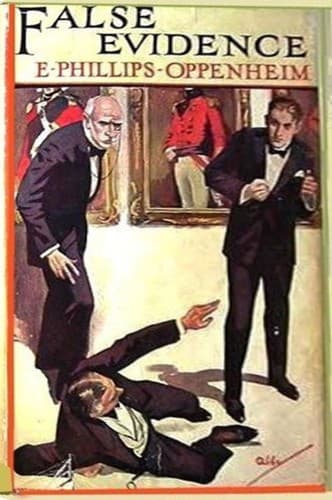
False EvidenceOppenheim, E. Phillips (Edward Phillips)
General
False Evidence
Oppenheim, E. Phillips (Edward Phillips)
Soldiers -- Fiction
No one, save they had known otherwise, would have taken it for anything
but a cowshed of the rudest form. It was built of boards dipped in
black tar, windowless, chimneyless, save for a hole in the roof through
which a small piece of dilapidated stove piping had been thrust, and
without the merest pretence of a garden. It stood, or rather leaned,
against one side of a sharp slope in the moor, and fifty yards from the
rude sheep-track which did duty as a road, and even in the daytime
there was no other human habitation within sight, or any sign of one.
With my arm in the bridle of the Black Prince, I led him down the
slope, and, grasping my riding-whip by the stock, knocked sharply at
what I concluded to be the door. I heard the quick sound of a man's
startled curse, and then there was a dead silence. I knocked again,
but no one answered. Then I kicked at the loose planks till the place
seemed as though it would tumble down like a pack of cards.
"What d'ye want?" a woman's shrill voice cried through the open chinks.
"Who be you?"
"I want your husband," I answered.
"Well, he bean't here, 'e bean't coom home."
"It's a lie!" I shouted back. "Tell him I shall not go away until I
have seen him, though I kick this place about your ears. Is he afraid?
Tell him I am alone."
She withdrew muttering, and I fastened Black Prince as securely as I
could against the wall. Suddenly the door was opened, and stooping
low, with my heavy riding-whip grasped firmly in my right hand, I
stepped inside.
At first I could see nothing, but just as I was cautiously feeling in
my pockets for a match, the red flames of a wood fire, which was
smouldering on the hearth, leaped up and showed me the bare walls and
miserable interior of the tumble-down hovel, showed me, too, the figure
of a tall, evil-looking man grasping a thick cudgel in his hand, and
peering through the gloom at me with a sort of threatening
inquisitiveness.
"What d'ye want wi' me?" the man began, suspiciously. Then suddenly he
dropped his cudgel and staggered back against the frail wall, with his
arms stretched out as though to keep me off.
"God, it's Muster Herbert! It's Muster Herbert's ghost. What d'ye
want? What d'ye want? What d'ye want here wi' me? Speak, can't you!"
he cried out in a tone of hysterical dread.
"Don't be a fool, John Hilton," I said, contemptuously. "I am Hugh
Devereux, son of the man against whom you swore a lie twenty-five years
ago, and I have come here to ask you a few questions."
He kept his eyes fixed upon me in a sort of sullen fascinated stare.
"First tell me why you swore that lie? It was Rupert Devereux who made
you."
The man's brute courage was returning to him slowly. He picked up his
cudgel and began to beat the side of his legs with it.
"You know how to command, young sir," he said, sneeringly. "Suppose I
say I won't answer your d--d questions?"
Public-domain text, read in full here on John Shaqi.
Reviews
Reviews
No reviews yet
Be the first to share your thoughts on this work.
Join the Discussion
Join the discussion
Sign in to leave a comment or review.
Sign InorCreate an account