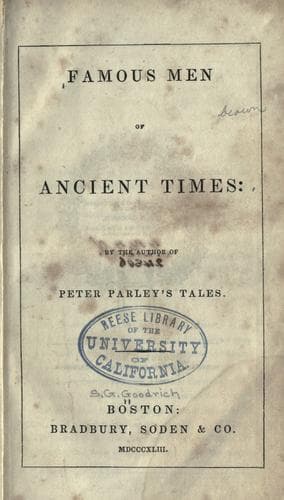
Famous Men of Ancient TimesGoodrich, Samuel G. (Samuel Griswold)
History
Famous Men of Ancient Times
Goodrich, Samuel G. (Samuel Griswold)
Biography -- Juvenile literature; Men -- Biography -- Juvenile literature
At last he seemed to be relieved, and being asked by Medias to a
carousal, he drank all day and all night, until he found a fever coming
upon him. He then desisted, but it was too late. The disease increased,
setting at defiance every attempt at remedy, and in the space of about
thirty days he died. Such was the miserable end of Alexander the Great.
His wife, Roxana, with the aid of Perdiccas, murdered Statira and her
sister, and the empire of the mighty conqueror was divided between four
of his officers.
The great achievement of Alexander—the grand result of his life—was
the subjugation of the Persian monarchy, which lay like an incubus upon
the numerous nations that existed between the Indus and the Euxine
sea, and at the same time intercepted the communication between Europe
and Asia. It was an achievement far greater than it would be now to
overthrow the Ottoman throne, and give independence to the various
tribes and states that are at present under its dominion. That he
accomplished this work for any good motive, we cannot maintain, for his
whole course shows, that, like all other conquerors, his actions began
and terminated in himself.
The character of Alexander has been delineated in the course of this
brief sketch. We have not been able to give the details of all his
battles, marches, and countermarches. His achievements were indeed
stupendous. He crossed the Propontis in 334, and died in 323. It was in
the brief space of eleven years, and at the age of thirty-three, that
he had accomplished the deeds of which we have given a naked outline.
Nor was he a mere warrior. He displayed great talents as a statesman,
and many of the traits of a gentleman. His whole life, indeed, was
founded upon an atrocious wrong—that one man may sacrifice millions
of lives for his own pleasure—but this was the error of the age. As
before intimated, considered in the light of Christianity, he was a
monster; yet, according to the heathen model, he was a hero, and almost
a god.
In seeking for the motives which impelled Alexander forward in his
meteor-like career we shall see that it was the love of glory—an
inspiration like that of the chase, in which the field is an empire,
and the game a monarch. In this wild ambition, he was stimulated by
the Iliad of Homer, and it was his darling dream to match the bloody
deeds of its heroes—Ajax and Achilles. It is impossible to see in his
conduct, anything which shows a regard to the permanent happiness of
mankind. He makes war, as if might were the only test of right; and he
sacrifices nations to his thirst of conquest, with as little question
of the rectitude of his conduct, as is entertained by the lion when he
slays the antelope, or the sportsman when he brings down his game.
Public-domain text, read in full here on John Shaqi.
Reviews
Reviews
No reviews yet
Be the first to share your thoughts on this work.
Elsewhere in the archive
Join the Discussion
Join the discussion
Sign in to leave a comment or review.
Sign InorCreate an account