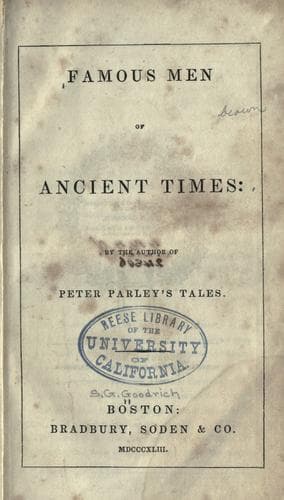
Famous Men of Ancient TimesGoodrich, Samuel G. (Samuel Griswold)
History
Famous Men of Ancient Times
Goodrich, Samuel G. (Samuel Griswold)
Biography -- Juvenile literature; Men -- Biography -- Juvenile literature
Although we see many noble traits in Alexander, the real selfishness
of his character is evinced in his famous letter to Aristotle. The
latter, having published some of his works, is sharply rebuked by
the conqueror, who says to him—“Now that you have done this, what
advantage have I, your pupil, over the rest of mankind, since you have
put it in the power of others to possess the knowledge which before was
only imparted to me!” What can be more narrow and selfish than this?
Even the current standard of morals in Alexander’s time, would condemn
this as excessive meanness.
We must not omit to record the last days of one that figures in
Alexander’s annals, and is hardly less famous than the conqueror
himself—we mean his noble horse, Bucephalus. This animal, more
renowned than any other of his race, died on the banks of the Hydaspes.
Craterus was ordered to superintend the building of two cities, one
on each side of this river. The object was to secure the passage in
future. That on the left bank was named Nicæa, the other Bucephala,
in honor of the favorite horse, which had expired in battle without
a wound, being worn out by age, heat, and over-exertion. He was then
thirty years old. He was a large, powerful, and spirited horse, and
would allow no one but Alexander to mount him. From a mark of a bull’s
head imprinted on him, he derived his name, Bucephalus; though some say
that he was so called in consequence of having in his forehead a white
mark resembling a bull’s head.
Once this famous charger, whose duties were restricted to the field
of battle, was intercepted, and fell into the hands of the Uxians.
Alexander caused a proclamation to be made, that, if Bucephalus were
not restored, he would wage a war of extirpation against the whole
nation. The restoration of the animal instantly followed the receipt of
this notification; so great was Alexander’s regard for his horse and so
great the terror of his name among the barbarians. “Thus far,” writes
Arrian, “let Bucephalus be honored by me, for the sake of his master.”
[Illustration]
ARISTOTLE.
This great philosopher was born at Stagira, or Stageira, in Macedonia,
384 B. C. His father, physician to Amyntas II., king of Macedonia,
commenced the education of his son, intending to prepare him for his
own profession; and the studies pursued by the latter with this object,
doubtless laid the foundation for that lore of natural history, which
he displayed through life, and which he cultivated with such success.
Aristotle lost both his parents while he was still young. After their
death, he was brought up under Proxenes, a citizen of Mysia, in Asia
Minor, who had settled in Stagira. Aristotle testified his gratitude to
Proxenes and his wife, by directing, in his will, that statues of them
should be executed at his expense and set up as his parents. He also
educated their son Nicanor, to whom he gave his daughter Pythias in
marriage.
Public-domain text, read in full here on John Shaqi.
Reviews
Reviews
No reviews yet
Be the first to share your thoughts on this work.
Elsewhere in the archive
Join the Discussion
Join the discussion
Sign in to leave a comment or review.
Sign InorCreate an account