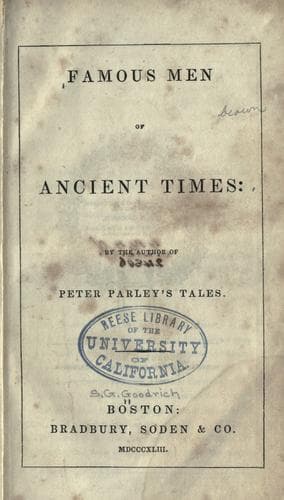
Famous Men of Ancient TimesGoodrich, Samuel G. (Samuel Griswold)
History
Famous Men of Ancient Times
Goodrich, Samuel G. (Samuel Griswold)
Biography -- Juvenile literature; Men -- Biography -- Juvenile literature
Aristotle remained at Athens till Plato’s death, 347 B. C., having at
that time reached his thirty-seventh year. Many stories are preserved
by the ancient compilers of anecdotes, respecting the enmity between
Plato and Aristotle, caused by the ingratitude of the disciple, as well
as by certain peculiarities of his character which were displeasing to
the master. But these rumors appear to have no other foundation than
the known variance between the opinions and the mental habits of the
two philosophers; and particularly the opposition which Aristotle made
to Plato’s characteristic doctrine of ideas; whence it was inferred
that there must have been an interruption of their friendly relations.
The probability, however, is, that Aristotle, at whatever time he may
have formed his philosophical opinions, had not published them in an
authoritative shape, or entered into any public controversy, before
his master’s death. In his Nicomachean Ethics, moreover, which was
probably one of his latest works, he says “that it is painful to him to
refute the doctrine of ideas, as it had been introduced by persons who
were his friends: nevertheless, that it is his duty to disregard such
private feelings; for both philosophers and truth being dear to him, it
is right to give the preference to truth.” He is, likewise, stated to
have erected an altar to his master inscribing on it that he was a man
“whom the wicked ought not even to praise.”
After the death of Plato, Aristotle left Athens and went to live at the
court of Hermeias, prince of Atarneus. He had resided here but three
years, when Hermeias, falling into the hands of the Persians, was put
to death. Aristotle took refuge in Mytilene, the chief city of Lesbos.
Here he married Pythias, sister of Hermeias, and who, being exposed to
persecution from the Persians, now coming into power there, he saved by
a rapid flight. For the patriotic and philosophical prince Hermeias,
Aristotle entertained a fervent and deep affection, and he dedicated
to his memory a beautiful poem, which is still extant. On account of
the admiration he expresses of his friend, he was afterwards absurdly
charged with impiety in deifying a mortal.
In the year 356 B. C., Philip of Macedon wrote a famous letter to
Aristotle, as follows: “King Philip of Macedon, to Aristotle, greeting.
Know that a son has been born to me. I thank the gods, not so much that
they have given him to me, as that they have permitted him to be born
in the time of Aristotle. I hope that thou wilt form him to be a king
worthy to succeed me, and to rule the Macedonians.”
Public-domain text, read in full here on John Shaqi.
Reviews
Reviews
No reviews yet
Be the first to share your thoughts on this work.
Elsewhere in the archive
Join the Discussion
Join the discussion
Sign in to leave a comment or review.
Sign InorCreate an account